

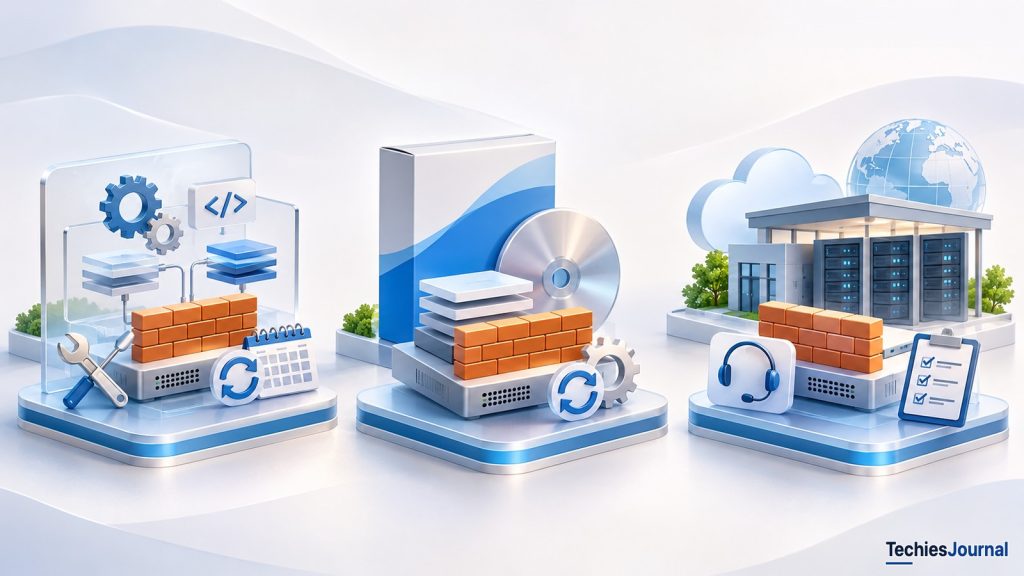
Free software, open-source code and commercial support describe different aspects of a firewall platform. pfSense, OPNsense, IPFire, Linux nftables and commercial NGFW products illustrate why the right choice depends on software architecture, ongoing updates, security services, support responsibilities and operational cost rather than the license price alone.
What do free, open-source and commercial actually mean?
Accessible text alternative for this figure
Three separate boxes describe cost to obtain (no-charge or paid), source rights (open-source or proprietary) and service model (community or contractual).
A fourth box below them says to evaluate these dimensions independently, because one platform can combine several characteristics.
The terms are often treated as competing firewall categories, although they answer different questions. Free usually describes what the user pays for a particular software offering. Open source concerns access to code and rights granted by its licenses. Commercial may describe a paid edition, a supported appliance, a subscription service or a proprietary software product. One platform can combine all three characteristics in different ways.
For instance, a vendor may maintain an open-source community edition while selling a separate product with additional capabilities or support. An open-source firewall can run on commercial hardware with paid professional assistance. A proprietary platform may include certain basic software features in the appliance price but require active subscriptions for security services. These distinctions influence the total cost and control of the deployment.
The practical question is not whether the firewall is labeled free or enterprise-grade. It is who maintains each critical component, who will help when it fails, which features stop or change when an entitlement expires, and whether the operating model suits the organization.
The software architecture behind a firewall platform
Accessible text alternative for this figure
Four stacked layers, from the bottom: operating system, drivers and physical or virtual hardware, then the packet-filter engine and routing, then security services such as VPN, IDS/IPS, feeds and logging, then management with GUI, API, configuration and backups.
The diagram shows that a turnkey firewall distribution packages more than a packet-filtering engine.
A firewall distribution is more than its packet-filtering engine. It normally combines an operating system, packet-filter framework, routing services, a management interface, configuration storage, update mechanisms, logging and optional services such as VPN, intrusion detection or web filtering. The distribution decides how these components are packaged, upgraded and operated.
A Linux or FreeBSD system configured with a packet-filtering framework can enforce powerful policies without a dedicated firewall distribution. But operating that system as a production network boundary also requires reliable network configuration, secure administration, backup and recovery, consistent logging and tested updates. An integrated firewall distribution supplies more of that operational framework.
The packet-filter engine should not be confused with all services layered around it. A web interface that simplifies creating network rules does not necessarily deliver application identification, an IPS signature feed or managed incident response. Conversely, a capable intrusion-detection package can exist on a free platform without any contractual guarantee about the timeliness of signatures or vendor support.
| Layer | What it supplies | Operational question |
|---|---|---|
| Operating system and drivers | Interfaces, routing, kernel security and hardware support | Who certifies and patches it for the target device? |
| Packet-filter engine | Rule enforcement and packet/flow handling | Which policies and traffic paths can it express? |
| Management and configuration | GUI, API or CLI, backups and change history | Can administrators reproduce and audit changes? |
| Security services | IPS, application or content rules, VPN and filtering | Which capabilities are included, optional or separately subscribed? |
| Support and lifecycle | Updates, advisories, technical help and replacement plans | Who responds during an outage, and on what terms? |
The comparison becomes clearer when we examine how real platforms divide those responsibilities.
pfSense editions and the announced single edition
pfSense Community Edition (CE) is Netgate’s open-source community project. pfSense Plus is a commercial Netgate product with premium capabilities that CE does not have. Netgate’s FAQ says that Plus has diverged from CE, and the two have carried separate version numbers and release schedules. Until now they could not be treated as interchangeable versions of one product.
That is about to change. In a blog post dated 29 October 2026, Netgate announced that starting with release 26.10 there is one edition of pfSense software, so the separate CE and Plus editions end. According to the same post, the full feature set is free on any amd64 hardware, every install receives security fixes at no cost, and upgrading from CE 2.9 to 26.10 is free and happens in place. Netgate says that what it charges for is convenience and help, namely online upgrades to new versions, fleet management at scale and support, and that existing Plus subscriptions carry over. These are Netgate’s own statements about a release that had not shipped on 16 November 2026, and Netgate’s FAQ and Plus overview pages still described CE and Plus as separate products when they were checked.
Under the model that applied until now, Plus was included on Netgate appliances, offered through cloud marketplaces and obtainable for eligible third-party installations through a subscription, according to Netgate’s FAQ. How that changes under a single edition should be confirmed from Netgate’s documentation after release. The evaluation point stays the same either way, because who maintains the software, who supports it and how updates reach the firewall remain separate questions from the license price.
Add-on packages are part of the operational boundary
The pfSense package documentation lists extensions for IDS/IPS, VPN, routing, monitoring and other services. Snort and Suricata are available as intrusion-detection and prevention packages. However, Netgate also explains that add-on packages differ in maturity and maintenance, and that packages from unsupported repositories can compromise an installation.
That difference matters during incident response. Troubleshooting a base packet-filter failure is not the same as diagnosing an IPS package, an external signature provider or a custom plugin. The responsibility for updates and support may differ even though everything is configured through one web interface.
A striking example of lifecycle risk appears in the Netgate package list, which marks Squid, SquidGuard and Lightsquid packages as deprecated because of unresolved upstream security vulnerabilities. A feature appearing in an old installation guide is therefore not evidence that it remains a defensible production choice.
Release status must be rechecked after 26.10
On 16 November 2026, Netgate’s release table identifies CE 2.9.0 as released in August 2026 and Plus 26.07 as released in August 2026. The table, which states that it was last updated on 24 August 2026, lists 26.10 as a future release with its release date still listed as to be determined. Netgate’s blog post says that 26.10 will be released before the end of November. Release 26.10 had not shipped at this checkpoint, so nothing here confirms that the single edition is available. Exact versions, upgrade paths and support terms should be rechecked after 26.10 is released and before they are relied on.
The practical lesson is that choosing an edition also means choosing a supported upgrade and maintenance path, not just a feature list.
OPNsense Community and Business Editions
OPNsense is an open-source firewall platform whose project licensing documentation identifies the BSD two-clause license for the project. Its community offering provides an integrated firewall distribution with a web-based management interface and an extensible service model.
The OPNsense Business Edition is a separate commercial delivery and update option oriented toward managed deployments. The project describes a more conservative approach to incorporating functional changes, a commercial firmware repository and additional business-oriented services. That is an operational difference, not proof that a community installation is inherently insecure.
Business and community versions do not necessarily move at the same release cadence or share the same feature staging. OPNsense documents a Business Edition 26.10 release on 28 October 2026, based on a preceding community release line with additional reliability changes. This illustrates a deliberate release-management choice. It does not establish that every Business Edition update is risk-free or that commercial support automatically performs an organization’s testing.
A purchaser should verify the relevant release stream, included support, hardware coverage, management options and any subscription-driven services. Some integrations and services are available through optional packages or commercial offerings rather than being guaranteed in every installation.
IPFire: one open-source firewall distribution
IPFire presents a different product model. It is a dedicated Linux firewall distribution, with the operating system and management services assembled for firewall use rather than provided as a generic server plus a small rule editor.
IPFire’s official feature documentation describes role-based network zones, stateful filtering, NAT, VPN services, an intrusion-prevention system based on Suricata, DNS and web-proxy functions, and add-on management through Pakfire. Its standard zone vocabulary includes RED for the external network, GREEN for trusted internal networks, BLUE for wireless segments and ORANGE for a demilitarized zone. Those labels are a platform-specific configuration model, not a universal requirement for firewall design.
IPFire says it offers a single software edition without per-feature license restrictions. That does not mean an organization has no costs. Hardware, administrator time, monitoring infrastructure, paid professional support, replacement inventory and operational recovery still need funding. IPFire’s project materials identify Lightning Wire Labs as an appliance and professional-support provider.
The open-source distribution model provides another choice in accountability. Organizations can inspect and adapt software, but the rights to source code do not guarantee that an internal team has the expertise to diagnose kernel drivers, VPN failures or a complex IPS deployment.
Linux nftables: a framework, not a turnkey distribution
nftables is a Linux packet-filtering framework within the Netfilter subsystem. It is powerful and appropriate for policy enforcement on hosts, routers or specially built firewall systems. It is not, by itself, a packaged firewall appliance with centralized web management, support contracts, curated add-ons and system recovery workflows.
This distinction matters to infrastructure teams considering a minimal custom Linux firewall. They gain direct control over policy representation and integration with configuration automation. They also take responsibility for selecting the distribution, configuring interfaces and routing, restricting administrator access, managing policy changes, collecting logs and planning upgrades.
A scripted nftables implementation can be a sound engineering choice for teams that have the needed skills and established operations. It is not automatically the simplest option merely because it has no software purchase cost. Conversely, adopting a full firewall distribution may introduce dependencies, plugins or interface conventions that are unnecessary for a narrowly defined host policy.
What commercial NGFW software changes
Commercial firewall platforms such as Fortinet FortiGate, Palo Alto Networks NGFW and Sophos Firewall combine security software with specific management, update and support models. Some are most commonly associated with appliances, while others can run virtually. These platforms may combine hardware acceleration with application-aware inspection, but the present comparison concerns licensing, lifecycle and support rather than packet processing.
Here the critical difference is contractual and operational. A commercial subscription may include IPS signatures, threat intelligence, malware analysis, web categorization, management integrations, replacement hardware or access to support teams. These entitlements are not standardized across suppliers. A procurement document that simply says “includes NGFW” is not sufficient to determine what the customer can use over a multi-year term.
The Sophos firewall licensing guide distinguishes support access and explains that security protection requires an active subscription. That statement describes Sophos licensing, not every commercial product. For any vendor, the consequences of expiration need to be checked service by service, including whether existing network policies remain active, signature updates stop or a security engine can no longer enforce its configured inspection profile.
Commercial support can lower the burden of finding specialists during a failure, but only within its terms. Response objectives, software coverage, escalation, hardware replacement geography and third-party integration support may all differ. A contract can improve escalation options without replacing the organization’s own change control and architecture knowledge.
Open source does not automatically mean less secure
Source availability creates transparency and the possibility of independent review. It also makes customization and migration possible within applicable license conditions. None of those properties proves that a particular deployment is hardened, updated or correctly configured.
Likewise, a proprietary license does not prove superior threat detection or availability. Security depends on implementation quality, update cadence, configured inspection, staff competence and the operating environment. A vendor’s support team cannot compensate for an organization leaving unnecessary management interfaces exposed or ignoring security advisories.
A reliable assessment should review release history, vulnerability disclosure practices, patch delivery, package maintenance, default configuration, backup/recovery capability and the level of evidence available for the features the organization intends to use.
How to establish trust in an open-source firewall
Accessible text alternative for this figure
Three boxes feed one result. Software integrity (official builds, signatures and dependencies), security response (advisories, patches and maintained releases) and control validation (scoped audits and authorized tests) all point to deployment-specific assurance.
Deployment-specific assurance includes operators, support and recovery. The diagram notes that an OWASP reference is not an OWASP product approval.
Before adopting a firewall as a production security layer, an organization should evaluate whether its security claims are supported by evidence. That evidence need not come from one approving institution. It should cover the specific product edition and release, the intended features, the deployment design and the team responsible for maintaining it.
OWASP is sometimes assumed to approve open-source security products. It does not. The OWASP Foundation’s non-endorsement policy states that OWASP does not endorse products, services or tools. Its Software Component Verification Standard guidance also makes clear that OWASP itself does not certify vendors, verifiers or software. A product’s appearance in an OWASP project or tool list should therefore never be presented as OWASP product approval.
OWASP guidance still has value where it matches the security problem. For example, the OWASP Application Security Verification Standard (ASVS) provides requirements for verifying web applications and related application security controls. That is useful when assessing an administrative web console or an application security integration, but it does not certify the firewall’s network enforcement, kernel, appliance or operational resilience.
A practical assurance review should request and examine the following evidence:
| Assurance area | Evidence to inspect | What it cannot prove by itself |
|---|---|---|
| Maintenance and security response | Supported release policy, recent advisories, patch times and disclosed CVEs | That future vulnerabilities will be fixed within a guaranteed time |
| Software provenance | Official downloads, checksums or signatures where provided, maintained repositories and dependency controls | That a correctly signed build has no exploitable vulnerability |
| Independent security review | Published third-party audits, scope, dates, findings and remediation evidence | That every component or current configuration has been tested |
| Control effectiveness | Documented policy behavior and authorized tests of required filtering, VPN, IPS and logging | That unused features or every traffic type receive the same protection |
| Secure operations | Administrative access restrictions, update and backup procedures, monitoring and recovery tests | That the organization will execute those procedures consistently |
| Accountability | Named internal owner, support arrangements, escalation paths and response targets | That community help or a paid contract guarantees uninterrupted service |
A product lacking an independent published audit is not automatically unsafe, just as one with an audit is not automatically secure. The decision depends on the risk of the deployment and the quality, scope and currency of available evidence. When evidence is missing, the organization must decide whether additional testing or compensating controls make the risk acceptable. For a critical security boundary, source-code availability alone is not a defensible sign-off.
Licensing also affects redistribution and trademark rights. Free access to source code should not be confused with permission to resell modified images under the original product name. Netgate and OPNsense both publish separate terms for software licenses and brand use. Integrators and appliance resellers need to examine those conditions before packaging a commercial offering.
Why the initial price is a weak cost comparison
A self-hosted firewall with no software license charge still needs a supported computing platform and a human operating model. The cost is distributed across hardware, installation, monitoring, upgrades, incident investigation, replacement planning and support.
A paid firewall may consolidate some responsibilities through a subscription or appliance contract, but that contract can also create renewal commitments, feature entitlements and supplier dependency. A lower initial purchase price can become costly if it requires custom integration or if critical support is unavailable during an outage. A high subscription price can be justified by requirements only when the contracted functions and service levels are actually used.
A practical cost model should capture the following:
| Cost area | Free or community-managed deployment | Commercially supported deployment |
|---|---|---|
| Software entitlement | May be zero, but edition-specific terms still apply | Appliance, software or recurring subscription charges |
| Hardware and resilience | Organization purchases and maintains the equipment | May be bundled, leased or bought separately |
| Security feeds and services | Some free, some separately licensed or externally maintained | Often tiered into subscriptions or bundles |
| Maintenance | Organization plans testing, upgrades and rollback | Vendor advisories and assistance may be included, local operations still needed |
| Support and recovery | Community forums, internal engineers or a paid third party | Contractual response and escalation within coverage limits |
| Integration and migration | Internal development and operational effort | Vendor tooling may help but can introduce licensing and portability limits |
The table compares responsibility models, not actual quoted prices. No single row applies identically to every product. For a real purchase, calculate the expected multi-year cost for the same workload, HA requirements, subscriptions and support coverage. Estimates should distinguish known contractual charges from staffing assumptions.
An engineering comparison across the main options
| Option | Software model | Operational advantage | Important boundary |
|---|---|---|---|
| pfSense (CE and Plus) | Netgate firewall software, an open-source community edition and a commercial edition until now, with a single edition announced by Netgate for release 26.10 | Integrated firewall/routing platform with extensions | Release 26.10 had not shipped at the 16 November 2026 checkpoint, so recheck editions, package lifecycle, upgrade path and support terms after release |
| OPNsense Community | BSD-licensed open-source firewall distribution | Integrated web management and extensibility | Organization manages update cadence and operational assurance |
| OPNsense Business | Commercial firmware/support model built around OPNsense | Conservative release staging and business-oriented options | Verify exact subscription, hardware and service coverage |
| IPFire | Open-source dedicated Linux firewall distribution | Unified firewall-focused operating environment and included capabilities | Operational ownership and optional professional support still matter |
| Linux nftables | Packet-filter framework within Linux | Direct policy control and automation integration | Not a complete managed firewall distribution by itself |
| Commercial NGFW platform | Product-specific proprietary and subscription models | Integrated inspection and vendor-backed support paths | Subscription expiry behavior, feature coverage and lock-in differ |
This is an architectural and operating-model comparison, not a security ranking. A product’s support status, available services and licensing terms can change by version and contract.
What should determine the selection?
Begin with the work the firewall must perform and the team that will operate it. A small office with a simple network boundary has different recovery requirements from a multi-site organization with around-the-clock operations, audit obligations and numerous remote users. The organization should not buy features it cannot operate, but neither should it rely on an unsupported deployment when downtime has substantial consequences.
The strongest selection process establishes expected traffic and inspection needs, update windows, available administrators, incident response expectations, support coverage, hardware replacement options and multi-year cost. Then it tests the shortlisted platform against those requirements using the supported software versions and the actual intended configuration.
A platform should be rejected if it cannot deliver a mandatory security service under the organization’s support and staffing constraints, regardless of whether its license is free or expensive. Conversely, a more costly platform should not be selected solely because it carries an enterprise label.
The decisive question is not who owns the source code or who issues the invoice. It is who can reliably maintain, secure, recover and support the firewall for the environment in which it operates.
References and further reading
- Netgate, pfSense Plus FAQ
- Netgate, pfSense Plus overview
- Netgate, pfSense software releases and FreeBSD versions
- Netgate, pfSense at 20, 29 October 2026
- Netgate, package management
- Netgate, current package list and deprecations
- OPNsense, licensing and trademark guidelines
- OPNsense, Business Edition
- OPNsense, Business Edition 26.10 release
- IPFire, about the project
- IPFire, platform features
- Ubuntu, nftables documentation
- Sophos, Firewall licenses
- OWASP Foundation, Non-Endorsement Policy
- OWASP, Software Component Verification Standard Assessment and Certification
- OWASP, Application Security Verification Standard