

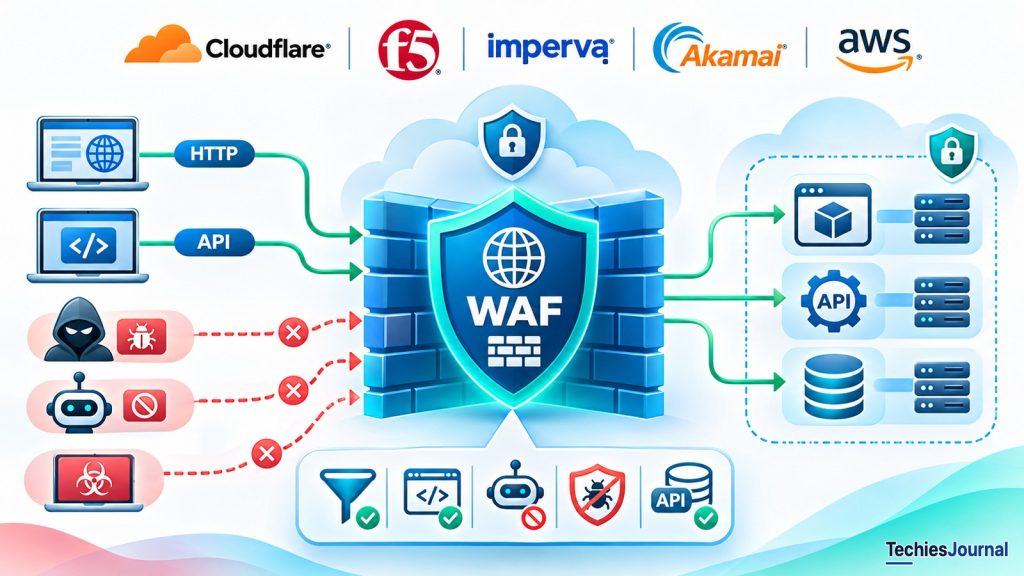
A web application firewall reads HTTP traffic and applies security rules before selected requests reach an application. But its effectiveness depends on placement, parsing, rule sets, anomaly scoring and tuning. Open-source engines such as ModSecurity and Coraza can use the OWASP Core Rule Set to detect common attack patterns, while API authorization and business-logic security still require protections inside the application.
What a web application firewall actually inspects
A web application firewall, or WAF, applies security policy to supported application-layer HTTP traffic. Where a network firewall can decide whether a connection is permitted, a WAF can examine elements of an HTTP transaction such as the request method, URL path, query parameters, headers and request body. Some WAF configurations can also inspect response headers and bodies. These additional fields give it a chance to detect common malicious request patterns, protocol anomalies and data exposure indicators.
A WAF is not automatically present because an application uses HTTPS, a reverse proxy, a cloud load balancer or an API gateway. A functioning inspection point must sit on the traffic path, decode the HTTP representation it is configured to support and run rules against the relevant fields. For HTTPS, the WAF generally needs to operate at a TLS termination point or behind a component that decrypts the traffic and forwards the HTTP request through a protected channel. If it only sees opaque encrypted bytes, it cannot match signatures against the concealed HTTP body.
Several deployment patterns are possible. A reverse proxy may terminate TLS and execute WAF checks before forwarding to the origin. A web server may load a security module. An ingress controller may integrate a WAF engine, while a managed cloud or content delivery service may run inspection at a provider-operated edge. An API gateway can add authentication or request validation alongside a WAF, but those are separate control functions.
A reference flow looks like this:
Client HTTPS request
         |
TLS termination and HTTP parsing
         |
WAF integration / inspection engine
         |
Rule set and configured exclusions
         |
Log, challenge or deny where supported
         |
Origin application and API authorization
         |
Optional response inspection and logging
         |
Client responseAccessible text alternative for this figure
A client HTTPS request passes TLS termination and HTTP parsing, then the WAF engine with CRS and custom rules, then the origin service, where API authorization happens.
From the WAF engine a branch leads to a log, deny or challenge outcome, depending on the configured enforcement mode. The diagram is conceptual, response inspection and engine actions vary by deployment.
The exact order of checks, supported actions and response visibility varies with the integration and engine. Some managed services have additional controls, such as bot scoring or rate limiting, that are not supplied by the OWASP Core Rule Set itself.
WAF operating modes: placement, enforcement and inspection
A WAF’s deployment mode, enforcement mode and detection method answer three different engineering questions. Deployment describes where HTTP traffic is intercepted. Enforcement describes what the system does after evaluating the traffic. Detection describes how suspicious activity is recognized. A deployment can combine different settings for all three, so describing a product merely as an inline or rule-based WAF is not enough to predict its behavior.
Deployment modes: inline and passive
An inline WAF is on the request path before the protected application. When its integration supports blocking, it can reject a request before the origin processes it. That can reduce application exposure and avoid spending backend resources on rejected requests. However, this placement also makes its availability, latency and failure handling part of the service architecture.
In passive or out-of-band monitoring, an observation component receives a copy or an independently exported representation of traffic. It can raise alerts without controlling the original request at the same point in time. This is useful for baselining traffic and examining false positives, but it should not be described as preventive protection. A passive WAF cannot reliably stop an already forwarded request merely by identifying it afterward.
These modes must not be conflated with detection-only enforcement on an inline WAF. An inline ModSecurity engine may still evaluate every request while allowing traffic to continue because disruptive actions are disabled. It remains located on the active traffic path even though the rules currently operate in monitoring mode.
Deployment architecture can also vary:
| Architecture | Where the WAF operates | Strength | Key condition or trade-off |
|---|---|---|---|
| Reverse proxy or cloud edge | HTTP traffic terminates or traverses a front-end proxy before the application | Central policy and inspection before origin access | Keep the origin from being reachable through an uninspected route |
| Web-server module or embedded engine | Rule engine is connected to the server handling HTTP requests | Close integration with request processing | Server and connector versions, memory, failure behavior and update ownership matter |
| API gateway or ingress integration | HTTP gateway provides access to request fields and executes supported WAF hooks | Common enforcement point for many API services | Gateway route coverage and protocol/body parsing must be validated |
| Transparent bridge or routed insertion | Supported appliance sits on a network transit path | May reduce application-facing changes | The chosen device must decode HTTP, handle TLS visibility and preserve supported traffic routing |
| Passive traffic analysis | Mirrored, exported or otherwise observed HTTP transaction data | Observability without immediate blocking risk | Detection after observation cannot substitute for inline request prevention |
These are architecture categories, not promises that every open-source WAF engine supports every deployment type. The OWASP WAF overview describes appliance, server-module and filter deployments. The Web Application Security Consortium’s historical WAF Evaluation Criteria (2006) similarly lists bridge, router, reverse-proxy and embedded designs. It is a useful classification reference, not a current certification or technical compatibility guarantee. Teams must verify the selected integration’s HTTP support, buffering, request-body limits and failure behavior.
Failure behavior: fail open versus fail closed
An inline WAF also needs an explicit strategy for what happens when the inspection engine, connector, proxy or managed endpoint becomes unavailable. Fail open prioritizes application availability by forwarding traffic without the intended inspection under a defined failure condition. Fail closed prioritizes the control boundary by refusing or interrupting traffic when inspection cannot be completed. Neither mode is universally correct. A financial API may require a stricter fail-closed behavior for sensitive operations, while a public information service may place greater weight on continuity, provided the residual risk is accepted.
The names are not enough to describe a product. A system can fail closed on a request-body size violation but fail open on engine timeout, or have different fallback behavior for selected routes. Review documented timeout handling, oversized payload policies, health-check routing, availability-zone failure and whether a direct origin path exists. Then validate the chosen failure behavior safely in a supported test environment. A configuration promising availability during firewall failures may also create an intentional inspection bypass.
Enforcement modes: observe, block and challenge
In ModSecurity, the SecRuleEngine directive supports On, DetectionOnly and Off. With On, the engine executes configured rules including supported disruptive actions. With DetectionOnly, it evaluates rules but does not execute blocking, dropping, redirecting or other disruptive actions. With Off, rules are not processed. The engine setting should be explicit because documented defaults differ between ModSecurity versions.
A managed WAF can offer more granular rule outcomes than this engine-level switch. For example, AWS WAF documents Allow, Block, Count, CAPTCHA and Challenge actions. Count records a match and continues rule evaluation without determining the final request outcome. Allow and Block normally terminate evaluation. Browser challenges can be terminating or non-terminating depending on whether a valid token is already present. These are AWS WAF capabilities, not universal actions of ModSecurity or OWASP CRS.
| Enforcement behavior | Immediate effect | When useful | Principal limitation |
|---|---|---|---|
| Detect or count | Record suspicious events but let evaluation or the request continue | Initial deployment and false-positive analysis | No immediate mitigation for traffic that reaches the origin |
| Block or deny | Stop the matching request before origin processing, if inline | Known malicious patterns or strict access policy | False positives can interrupt legitimate users |
| Challenge | Ask an eligible client to prove some characteristic before proceeding | Suspected automated browser traffic | Browser compatibility, accessibility and API-client limitations |
| Rate limit or throttle | Restrict requests exceeding a configured volume or cost condition | Login abuse, scraping and resource pressure | Distributed attackers and costly single requests may still succeed |
| Allow or explicitly bypass | Permit a matching request or skip selected checks | Narrow, evidence-backed exceptions | Broad exceptions can unintentionally bypass later security rules |
Blocking a request may return a specific HTTP status code or custom response. A block does not reverse a transaction already processed by an origin, and a passive deployment cannot retroactively prevent an earlier action. Conversely, allowing a request at one WAF stage may not mean that all security checks have run. In Cloudflare’s documented phase order, an earlier terminal action can prevent later managed-rule inspection. Its Skip action can intentionally bypass selected later features. These behavior differences are reasons to inspect effective policy execution rather than rely on the presence of a product logo.
Detection methods: signatures, positive models, scoring and behavior
Signature or negative-security rules search for patterns associated with known attack techniques. Generic CRS signatures can recognize suspicious HTTP structures even when the application has not defined every permitted input. Their weakness is that novel representations, parser mismatches and application-specific semantics may escape a generic pattern.
Positive-security or allowlist rules describe permitted methods, routes, content types, field structures or values. For an API with stable contracts, a gateway or custom rule can reject requests that violate the contract. This reduces the accepted input surface, but only when the contract is precise and changes are coordinated with clients. Valid-looking requests can still be unauthorized.
Anomaly scoring combines rule observations and compares their total against a threshold. OWASP CRS uses this method, with sensitivity affected by included rules and paranoia levels. A score expresses the selected rules’ observations, not a measured probability that the request is malicious.
Behavioral and reputation-based controls examine activity over time, request rates, session patterns, IP or account reputation, bot indicators or other contextual signals. Such features are often provider-specific additions and should not be attributed automatically to the open-source CRS. They may reduce automated abuse, but the grouping key, sampling window, false-positive sensitivity and evasion resistance must be understood.
A mature protection policy often combines these methods. For example, a login endpoint might use syntax-based WAF rules against injection patterns, a schema validator for request fields, identity-aware rate controls against repeated attempts and application-enforced lockout or step-up authentication where appropriate. One control need not make every decision.
Three components that should not be confused
An open-source WAF installation commonly brings together a traffic integration, a rule engine and detection rules. Those components can have separate maintainers, versions and security requirements.
| Component | Responsibility | Important distinction |
|---|---|---|
| Web server, proxy or gateway connector | Supplies HTTP transaction data to the WAF and applies supported decisions | Unsupported body types, protocols or buffering modes affect what reaches the engine |
| WAF engine | Parses variables, applies transformations, evaluates rules and performs actions | Its version and implementation determine supported syntax, phases and limits |
| Rules and policy | Describe patterns, thresholds, exclusions and enforcement choices | Adding a rule set does not guarantee that blocking or request-body inspection is enabled |
ModSecurity: different engine generations
ModSecurity is a widely used open-source HTTP transaction filtering engine. ModSecurity 2.x is commonly deployed as an Apache module. ModSecurity 3.x, also known as libModSecurity, provides an independent engine library with connectors that integrate it with web servers such as NGINX or Apache. An operator must distinguish the engine, its connector and its rule set when diagnosing compatibility.
The project maintains separate v2 and v3 branches and release notes. As of 16 November 2026, its official releases list security maintenance updates for both generations, including v2.9.15 and v3.0.17 released in September 2026. Those release notes describe fixes for parsing, decoding and other security issues. Such updates illustrate why the WAF engine itself needs vulnerability response and patch management, rather than being treated as an invulnerable security intermediary.
ModSecurity’s documented processing phases include request headers, request body, response headers, response body and logging. A rule cannot evaluate an unavailable request body in a phase that has only received headers. Similarly, a rule configured for response content cannot inspect a response body that the deployment has not buffered or enabled.
Coraza: another engine for security rules
Coraza is a Go-based open-source WAF engine supporting ModSecurity-style rule configuration. Its documentation recommends an integration through the coraza-coreruleset Go package, which embeds the Core Rule Set and associated configuration. It also documents a manual loading sequence for the recommended engine configuration, CRS setup and rule files.
This does not mean every ModSecurity directive or connector works identically in both engines. Ruleset compatibility, supported transformations, request-body parsers, memory limits and integration behavior should be checked for the selected Coraza version and deployment.
OWASP Core Rule Set: detection content, not a standalone gateway
The OWASP Core Rule Set (CRS) is a community-maintained collection of generic application-attack detection rules designed to run on compatible WAF engines. It includes detections for attack classes such as SQL injection, cross-site scripting, local file inclusion, protocol anomalies and suspicious request patterns.
CRS does not independently terminate TLS, route requests or enforce account authorization. It depends on an engine and integration, and its blocking behavior depends on the deployment configuration. A product advertising “OWASP CRS compatible” is therefore making a compatibility claim, not showing an OWASP product approval, a successful security test or assurance that every application vulnerability is covered.
HTTP methods and transaction directions matter
A WAF must evaluate the actual methods used by the application. A GET request typically exposes path, query and headers. POST, PUT and PATCH often place important input in JSON, form, XML, multipart or other supported bodies. DELETE may have no body, but its authorization and effect can be more sensitive than a read. HEAD and OPTIONS have legitimate protocol uses, and an API may require WebSocket upgrades or other HTTP features that the particular integration handles differently.
A positive-security policy can allow only the methods a route needs, such as GET for a read-only endpoint and POST for creating a resource. That reduces unnecessary entry points but does not make POST intrinsically dangerous or GET intrinsically safe. The decisive checks are whether the verb is supported on that route, whether its parameters are valid, and whether the caller has permission for the operation. HTTP method restrictions cannot replace anti-CSRF protections, authentication or application business rules.
Response inspection is another independent capability. Some WAFs can evaluate response status, headers and selected bodies for leakage or injection-related indicators, while others focus entirely on requests. If an outbound data-leakage rule blocks a response, the application may already have performed its database write or other side effect. Detection direction and the time at which the action executes should be identified during design.
Which attacks can a WAF mitigate, and how?
The term WAF protection is sometimes used as if it were a guarantee against all attacks on a website. A more accurate statement is that a WAF can reduce exposure to classes of HTTP attacks it can observe and recognize. The outcome depends on coverage, configured rules, content visibility and whether the relevant action executes before the origin processes the request.
The OWASP WAF description identifies SQL injection and cross-site scripting as common examples. OWASP CRS extends detection to other attack families, including local and remote file inclusion, remote code execution patterns, protocol misuse and some response data leakage. The CRS anomaly-scoring guidance explains that detection strength and blocking thresholds vary by rule category. Managed WAFs may add specialized bot, credential-abuse and DDoS-related controls that go beyond generic CRS coverage.
| Attack or abuse type | How a WAF may reduce impact | Where protection stops |
|---|---|---|
| SQL injection (SQLi) | Inspect decoded parameters and supported bodies for suspicious query-language structures, then block matching transactions | Parameterized queries, database permissions and secure application code remain essential |
| Cross-site scripting (XSS) | Detect suspicious script-related payload patterns in supported request fields and sometimes responses | Contextual output encoding and application content security remain necessary, especially for stored or client-side XSS |
| Path traversal and local file inclusion (LFI) | Identify suspicious path references, encoding tricks and file-access patterns in HTTP input | Filesystem permissions and secure server-side path handling are the primary safeguards |
| Remote file inclusion (RFI) or remote code execution (RCE) attempts | Match supported inclusion, command-execution or known exploit signatures | Unknown vulnerability variants, unsafe deserialization and vulnerable application components may bypass generic rules |
| HTTP protocol and parser anomalies | Reject malformed headers, unusual encodings and unsupported request structures when rules/integrations expose them | Different parsers may interpret a request differently, so origin/proxy consistency and patching remain critical |
| Credential stuffing and login automation | Use supported rate limits, bot indicators, challenge actions and account-aware controls to reduce automated volume | Compromised credentials may still be valid, and IP-only thresholds can be ineffective or disruptive |
| HTTP request floods and resource exhaustion | Rate-limit, challenge or block excessive requests before they reach expensive origin logic | Volumetric DDoS also needs upstream network capacity and provider protection. Single expensive operations need application controls |
| Scanner activity and known exploit attempts | Use managed or custom signatures for recognizable reconnaissance and known vulnerability patterns | Signatures can lag new exploit variants, and scanner-looking traffic may also be legitimate |
| Sensitive-data disclosure through responses | Use supported response-body rules to identify selected leakage patterns before delivery | Response inspection may be disabled or limited, and withholding output does not undo earlier backend actions |
| Broken object-level or function-level API authorization | Usually no reliable generic mitigation based only on HTTP syntax | The backend must decide whether the authenticated principal can act on the specific object or function |
| Business-logic abuse and fraud | Rate and anomaly signals may help identify unusual volumes or repetitive sequences | The application must validate business state, user entitlements and transaction invariants |
For example, an SQL injection signature that blocks a suspicious request may prevent that particular attempt from reaching a vulnerable endpoint. It does not repair the underlying database query. If the same flaw can be reached through a different encoding, direct origin URL, unsupported body parser or internal service, the application remains exposed. WAF protection is a compensating layer, not evidence of vulnerability removal.
What happens during mitigation?
For an inline WAF, the order matters. A client sends a request. The inspection point parses supported HTTP fields and evaluates configured rules. A matching rule may record a warning, add to an anomaly score or invoke a block or challenge action. If the policy terminates the request before forwarding, the origin does not process that request. That can reduce exposure to the targeted attack pattern and save some backend work.
For a detection-only WAF, the same rule match may generate an alert while the origin still receives the request. This is suitable for testing and tuning, but not sufficient when a known malicious pattern must be stopped immediately.
For rate limiting, mitigation is measured over a stream of requests instead of one payload. Depending on the product, the limiter may apply to a client address, account identifier, token, custom characteristic or estimated request complexity. A poorly chosen key can let distributed automation continue or penalize users behind a shared network. The AWS WAF rate-based rule guidance distinguishes a block from a Count action, which merely records a rate match without stopping it.
For browser challenges, the service may require client-side proof before forwarding. AWS’s challenge documentation explains that a valid challenge token allows further evaluation, while missing or expired tokens can terminate the request. Browser-oriented challenges may be inappropriate for machine-to-machine APIs, mobile SDKs or accessibility-sensitive flows unless the integration supports them explicitly.
Attack visibility is the limiting condition
A WAF cannot evaluate what its deployment does not receive or cannot interpret. Important limitations include uninspected direct-to-origin traffic, unsupported protocols, request bodies larger than inspection limits, streaming or chunked representations not fully processed by the integration, encrypted content outside the TLS termination boundary, mismatches between the WAF and origin parsers, and exclusions that skip too much traffic.
The Cloudflare managed-rules documentation describes plan-dependent request-body inspection limits and warns that uninspected portions of larger payloads affect what the rules can detect. That is a concrete example of why an organization must check the effective inspection boundary rather than assume that every byte of every request is analyzed.
The strongest impact-reduction evidence combines three observations: the intended HTTP flow reached the WAF, the relevant inspection rule or control evaluated it, and the resulting action prevented or limited the targeted outcome. A blocked request log alone cannot show that all variants of the vulnerability are mitigated, while a lack of alerts cannot establish that the application is safe.
From HTTP bytes to a rule decision
The technical value of a WAF comes from processing the HTTP transaction in a way that permits meaningful comparisons. A request might contain a query parameter, JSON object, multipart upload or URL-encoded form body. The integration must expose the relevant content, and the engine must interpret it using the configured parser and transformations.
For an ordinary query request such as GET /search?q=network, a WAF can evaluate the path and parameter value. For an API request containing JSON, inspecting fields inside the JSON body depends on whether the engine and connector support that content type and whether body inspection is enabled. A rule written for a URL parameter will not necessarily inspect nested JSON values unless the engine exposes them to the appropriate variables.
Normalization matters because the same semantic input can have different representations. Rules may apply URL decoding, character normalization or case handling before comparison. This helps detect encoded patterns, but the WAF’s interpretation should align as closely as possible with the origin application’s parser. If a proxy, WAF and application disagree about content boundaries, duplicate parameters or encodings, the control can miss an attack or reject a legitimate request.
The ModSecurity v3 reference manual documents request-body and response-body access controls, size limits and policies for handling oversized bodies. Processing only part of a large body can create a visibility gap. Rejecting oversized bodies may protect inspection integrity while disrupting legitimate uploads. These options must be evaluated against the application’s actual traffic rather than copied blindly from a generic configuration.
A WAF also has practical blind spots. It may not inspect unsupported binary protocols, end-to-end encrypted payloads, traffic taking a direct origin path around the proxy or application state that is not included in the HTTP request. A perfectly configured rule set cannot defend an application if requests bypass the enforcement point.
How OWASP CRS anomaly scoring makes decisions
OWASP CRS normally uses anomaly scoring rather than letting each matching detection rule immediately terminate a request. Each matched rule contributes a score associated with severity. After the applicable request rules are evaluated, the WAF compares the accumulated inbound score against a configured blocking threshold. For enabled response inspection, it can perform an independent outbound scoring and blocking decision.
The CRS anomaly-scoring documentation describes default severity contributions of CRITICAL 5, ERROR 4, WARNING 3 and NOTICE 2. Its documented default thresholds are 5 inbound and 4 outbound. These figures describe the CRS configuration defaults, not a universal WAF requirement or observed detection accuracy.
Consider an illustrative request with these hypothetical matches:
| Detected signal | Example score added |
|---|---|
| One WARNING-level rule matches | 3 |
| One NOTICE-level rule matches | 2 |
| Inbound anomaly score | 5 |
With the documented inbound threshold of 5, the combined score meets the block condition if the WAF is running in the appropriate blocking mode. One individual warning score of 3 would remain below that same threshold. The scoring model lets several weaker observations combine into a stronger decision. It does not prove every malicious request will reach the threshold or every legitimate request will remain below it.
Accessible text alternative for this figure
A WARNING-level rule match adds 3 and a NOTICE-level rule match adds 2, which gives an inbound anomaly score of 5.
At the configured threshold of 5 the request is blocked if enforcement is enabled and otherwise logged. A verified false positive calls for a narrow exclusion, not blanket rule removal. The scores are illustrative and not measured detections.
The inbound and outbound decisions occur at different times. A blocked inbound request need not reach the application. An outbound score is evaluated only after the backend has processed the request and produced response data. A decision to withhold a suspicious response may prevent disclosure to the client, but it cannot undo business actions the application already performed.
Some deployments enable early blocking, which uses earlier processing phases to reject a request whose existing score has already crossed the threshold. Early blocking can reduce unnecessary body processing, but it alters which later rules execute and what forensic evidence is available. Treat phase behavior and blocking mode as part of the security design.
Paranoia levels change sensitivity
CRS also organizes detection rules by paranoia level (PL). Higher paranoia levels enable additional and generally more aggressive detection rules. As a result, they can identify patterns not covered at lower levels, but they also tend to increase false positives. The CRS tuning guidance recommends starting from a level appropriate for the application and tuning before increasing enforcement sensitivity.
Paranoia level is distinct from the anomaly score threshold. Enabling more rules can produce more matches. Raising the threshold makes blocking less likely for a given set of matches. Increasing both settings simultaneously can make the policy difficult to reason about because one change adds signals while the other weakens the final decision. Teams should record each change and compare real traffic outcomes before making the next adjustment.
False positives are an operational security problem
A false positive occurs when a legitimate HTTP transaction matches a WAF detection rule or accumulated score and is treated as suspicious. This is particularly relevant for applications that legitimately accept source code, search expressions, HTML fragments, JSON filters or other content resembling attack patterns.
Imagine a software documentation portal with an API that lets authenticated authors save example code snippets. A valid JSON field contains text that resembles a command or query. The WAF logs a rule match, and the request reaches or exceeds the configured block threshold. Users experience a failed save operation even though the content is allowed by the application.
A safe tuning process begins with evidence. First, correlate the request identifier and timestamp with the WAF event, matched rule IDs, target fields and score. Second, determine whether the application behavior is legitimate and reproducible. Third, identify the narrowest acceptable exception, such as excluding one known data field from a particular rule for that API route. Fourth, test both the legitimate request and relevant unwanted requests before enabling the exception broadly.
The CRS false-positive guidance distinguishes configure-time exclusions, which are placed after the relevant CRS rules have been included, from runtime exclusions, which must execute before the CRS rules they are intended to alter. Misplacing an otherwise correct exclusion can make it ineffective.
A broad rule exclusion removes protection for more traffic than the application may require. Raising the global anomaly threshold merely to stop one false positive is also risky because it raises the bar for detecting unrelated attacks. The preferred correction is narrowly scoped and documented, with subsequent monitoring to detect regressions.
Safe rollout from observation to enforcement
A practical WAF rollout starts by capturing representative normal traffic and running detection-only or monitoring behavior where the chosen product supports it. Teams should determine which rule IDs fire, whether important transaction bodies are visible, how different endpoints behave and whether an alert corresponds to a true security concern.
After tuning, the team can progressively enable blocking for selected applications or traffic categories. This is not a guarantee that every attack is detected. The deployment should include a rollback path and periodic retesting when applications, CRS rules, request parsers or WAF engines change. Alert volumes by themselves are not a quality metric. A low alert count can indicate insufficient visibility as easily as excellent tuning.
How WAF protection relates to API security
APIs use HTTP but introduce authorization and data-access concerns that generic attack signatures cannot reliably decide. The OWASP API Security Top 10 (2023) covers risks such as broken object-level authorization, broken authentication, property-level authorization problems, uncontrolled resource consumption and unrestricted access to sensitive business flows.
A WAF may identify malicious request syntax, block some known attack patterns, enforce supported size limits and apply rate-limiting integrations. An API gateway may validate OAuth tokens, schema shapes, quotas or consumer policies. The application must still enforce its actual domain-specific authorization decisions. No one of these controls replaces the others.
A normal-looking API request can still be unauthorized
Consider an authenticated banking customer requesting GET /api/accounts/842/transactions. The HTTP syntax is ordinary. Whether the user may retrieve account 842 is determined by application identity, account ownership and delegation rules. If the backend fetches the account record without checking that relationship, the endpoint may have broken object-level authorization (BOLA).
OWASP explains that API object identifiers may appear in paths, queries, headers or request bodies, and that the application must enforce authorization for each requested object. A generic WAF does not inherently know which account belongs to which customer. Rules that reject certain number formats or paths would be unreliable and could block legitimate users.
The application-level correction is to bind the authenticated principal to an authorized resource lookup, perform authorization on every affected operation, and test attempts to access resources belonging to other users. WAF telemetry can complement that control by identifying patterns of unusual access, but it is not a substitute for the ownership check.
Business logic, rate limiting and schema validation
An API may also be abused through requests that are syntactically valid but violate business intent. Examples include automated attempts to exhaust a reservation inventory, repeatedly trigger expensive workflows or exploit an unintended purchase sequence. A signature-based WAF may not understand such sequences without application-specific signals and constraints.
Rate limits are useful but depend on a reliable identity or grouping key, not only a source IP address. Schema validation can reject malformed or unexpected payloads but cannot decide whether a valid field value is authorized for a particular customer. Property-level authorization is also separate from the detection of suspicious characters in a JSON field.
A more complete API security design distributes responsibility clearly: the WAF inspects supported HTTP patterns, the gateway enforces applicable admission and consumer controls, and the application verifies authentication, authorization, data ownership and state transitions. Logs should preserve enough context to investigate without unnecessarily exposing tokens, passwords or sensitive transaction data.
Managed WAF and self-hosted inspection are operating models
A managed WAF service may simplify rule deployment, provider updates and large-scale traffic handling. A self-hosted ModSecurity or Coraza integration offers greater control over deployment and rule execution. Neither category guarantees better detection by default, and the rule sets offered by different managed providers are not automatically the same as OWASP CRS.
Teams comparing the options should ask where TLS ends, which HTTP protocols and content types are inspected, what occurs on a rule-engine failure, which updates are controlled by the provider, how rule changes are tested, and how access to logs is restricted. The correct comparison includes false-positive operations, response time to new vulnerabilities, deployment portability, availability and recurring cost, not just the headline number of managed rules.
A critical part of the threat model is origin bypass. If an internet client can call a public origin server directly while skipping the protected reverse proxy or edge service, WAF rules at that edge cannot protect the bypassed request. Organizations should restrict origin access to the intended front-end path using supported network controls, private connectivity, authentication or signed origin requests as applicable.
The security of the WAF itself needs maintenance
A WAF engine parses potentially hostile inputs, so the engine, connectors and parsers are part of the application’s exposed attack surface. The ModSecurity release history records security fixes for malformed inputs and parsing behavior. Similarly, the CRS project security policy identifies supported release branches and published advisories affecting detection rules.
As of 16 November 2026, CRS documents the v4.25.x long-term-support line through Q3 2027, alongside support for the latest two point releases on the current development line. CRS v3.3.x reached end of life in Q3 2026 according to the project’s current security policy. Those lifecycle facts are time-sensitive, and readers should reconfirm the latest supported versions before relying on them.
Open-source transparency permits review and contributions, but it is not security certification. Deployments need trusted release artifacts, pinned or controlled versions, timely security updates, connector compatibility testing and a recovery plan. An organization that rarely updates its WAF rules or engine may miss new detections or leave known vulnerabilities in the security layer itself.
What an engineer should verify before relying on a WAF
A credible WAF rollout provides evidence for all the following. The acceptance criteria should distinguish prevented requests, observed suspicious requests and application vulnerabilities that require software fixes. A WAF can lower the likelihood or volume of successful attacks that match covered controls without eliminating the underlying bug:
- Coverage: Enumerate public hostnames, API routes and alternative origin paths. Confirm intended HTTP traffic actually reaches the enforcement point.
- Visibility: Identify the supported methods, HTTP versions, body types, size limits, transformations and TLS termination boundaries.
- Policy: Record engine version, CRS release, paranoia level, inbound and outbound thresholds, rule exclusions and blocking mode.
- Correctness: Exercise authorized normal requests, unusual but legitimate application input, and safe simulated rule triggers in a controlled environment.
- API ownership: Confirm that authentication, object authorization, property permissions and business restrictions are enforced by the application or appropriate identity-aware services.
- Evidence: Correlate WAF events with gateway and application logs without storing unnecessary sensitive content.
- Lifecycle: Test rule updates, engine upgrades, availability behavior, configuration rollback and changes in false-positive rates.
A WAF can be a valuable additional boundary against known HTTP attack patterns, but it cannot make an insecure application secure by itself. The strongest outcome is a deployment in which requests reliably traverse inspection, rules are tuned against real application behavior, and the application independently enforces the permissions that only it can know.
References and further reading
- OWASP ModSecurity project
- OWASP ModSecurity release notes
- ModSecurity reference: processing phases
- ModSecurity v3 reference: request and response body limits
- Coraza: OWASP CRS integration guide
- OWASP Core Rule Set
- OWASP: Web Application Firewall
- WASC: Historical Web Application Firewall Evaluation Criteria (2006)
- ModSecurity: Engine modes and configuration directives
- AWS WAF: Rule actions
- AWS WAF: Rate-based rules
- AWS WAF: CAPTCHA and Challenge
- Cloudflare WAF: Rule execution order
- Cloudflare WAF: Skip actions
- Cloudflare WAF: Managed-rule and body-inspection limits
- CRS anomaly scoring
- CRS false-positive tuning
- CRS security policy and supported releases
- OWASP API Security Top 10 (2023)
- OWASP API1:2023 Broken Object Level Authorization