

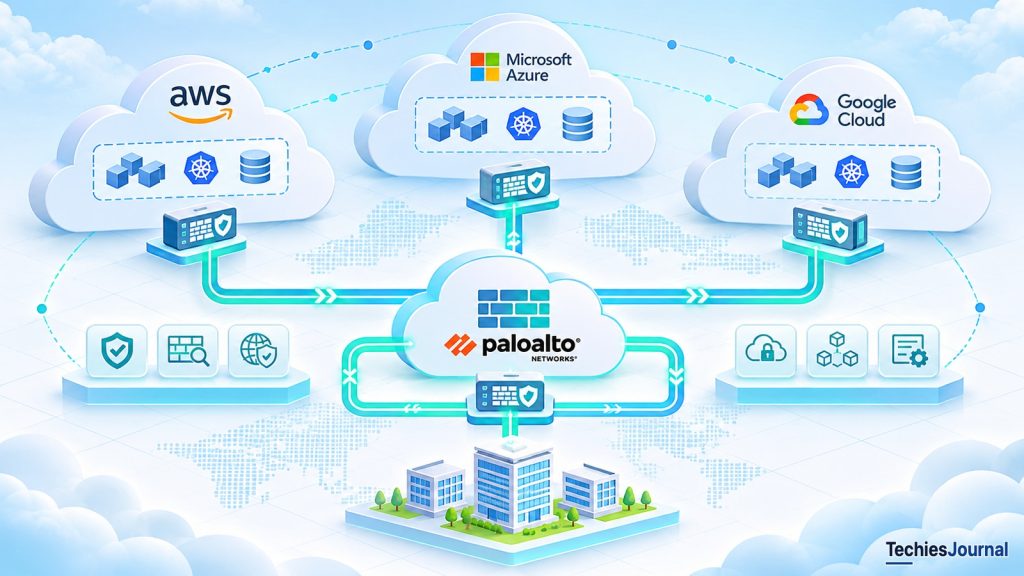
A cloud firewall is not necessarily a virtual copy of a physical appliance. Some services inspect traffic through routed endpoints, while others enforce policy directly at supported workloads. Understanding where a decision is made, how packets reach inspection and who maintains each component is essential for building secure AWS, Azure, Google Cloud and hybrid networks.
What is a cloud firewall, and where does it operate?
A cloud firewall is a security control that applies policy to traffic involving cloud-hosted resources. It may be a customer-managed virtual firewall appliance, a managed inspection service or a distributed network policy mechanism built into the cloud provider’s networking system. These approaches can coexist within the same architecture.
A virtual appliance runs firewall software on virtual machines or other supported compute infrastructure. The organization is typically responsible for software lifecycle, capacity planning, traffic steering and the appropriate resilience configuration. A managed firewall service shifts much of the inspection infrastructure and service maintenance to the cloud provider, but often still requires the customer to choose policy and route traffic through the service. Distributed policy enforcement works differently. The cloud network applies eligible rules at supported enforcement points, reducing the need to funnel ordinary network-filtering decisions through one customer-controlled appliance.
These designs cannot be compared by checking whether each has an allow and deny rule. The important questions are where enforcement happens, which flows are covered, how advanced inspection is invoked and whether a failure or route change can allow traffic to avoid the intended control.
| Control model | Typical enforcement location | Customer responsibility | Common limit |
|---|---|---|---|
| Virtual network firewall appliance | Virtual machine or appliance interfaces inserted into a routed path | Appliance configuration, software updates, scale, availability and traffic steering | Unrouted or asymmetric traffic can bypass inspection or break sessions |
| Managed routed inspection service | Cloud-managed firewall endpoints or a dedicated managed firewall service | Security policy, networking, endpoint placement and logging integration | A policy object alone does not redirect every intended flow |
| Distributed cloud firewall policy | Provider-defined enforcement points associated with supported workloads and resources | Rule scope, hierarchy, targets, change control and audit | A network allow/deny rule does not automatically provide content inspection |
| Workload-native control | Security group, network security group or equivalent workload/network policy | Least-privilege rules and workload associations | Does not replace dedicated intrusion prevention or advanced content analysis |
The models overlap. A cloud deployment may use distributed controls for basic segmentation, managed inspection for high-risk network paths and host policy for local workload protection.
Enforcement and routing are separate decisions
Consider an application subnet that must reach the internet through an inspected path. Two independent conditions must be true. First, the firewall’s policy must permit or deny the relevant traffic according to requirements. Second, the cloud network must deliver that traffic to the firewall’s enforcement point.
In a routed inspection architecture, the workload’s route directs the selected flow to a managed firewall endpoint before sending it toward its destination. In a distributed policy model, supported workloads receive policy decisions without an equivalent customer-managed transit route.
Accessible text alternative for this figure
Routed inspection: a workload subnet sends traffic through route-table steering to a managed inspection service and then to the destination.
Distributed policy: a supported workload has policy evaluated at the target boundary, which allows or denies the network flow without a customer-managed transit route.
The diagram is conceptual and not a vendor implementation diagram.
This is a schematic, not a universal cloud routing diagram. Source and destination address translation, gateway location and individual route-table behavior vary between providers.
A firewall can exist with perfectly written rules yet see no traffic because the application subnet uses another default route. Conversely, a routing change that sends a flow to the firewall does not guarantee the policy allows it or that a destination service will accept it. An effective architecture therefore validates the actual traffic path along with the rule set.
Central inspection and local controls serve different purposes
A central inspection point can consolidate security services and logs across several networks. It can also create a dependency on transit routing, cross-zone links and capacity shared by many workloads. Distributed controls can provide broad enforcement near supported resources, but advanced application inspection might still require separate endpoint resources.
The appropriate design is not automatically “centralize everything” or “distribute everything.” Low-risk workload-to-workload traffic, internet egress, traffic from on-premises networks and access to critical services may need different enforcement combinations. The decision depends on the required visibility, failure domains, scale and operations model.
Trace a connection through the enforcement architecture
Suppose a private application needs to establish an outbound HTTPS connection to an approved service. An architecture review should trace six decisions rather than asking only whether a firewall rule exists.
- Identify the source and destination. Record the workload interface, resolved destination address, protocol and port. Where hostnames matter, determine whether a rule uses IP addresses, DNS names or application context.
- Resolve the effective forward route. Check the route selected in the source network and at each relevant gateway. Verify that this path reaches the intended enforcement point rather than a direct internet route or an uninspected private link.
- Determine the applicable policy. Establish which security-group, network-rule or hierarchical policy controls apply to the source and destination. A rule defined in an unrelated scope has no effect.
- Determine the inspection level. A permitted TCP connection may pass network filtering without receiving IPS or decrypted-content inspection. Confirm which enabled security service evaluates the traffic.
- Trace the return traffic. Stateful routed inspection may require the reply to pass through the same endpoint or flow-affinity group. Also check network address translation and gateway behavior where present.
- Confirm what actually happened. Compare the effective configuration with firewall events, routing evidence and an authorized connection test.
For example, a route from an application subnet to a firewall endpoint proves only that the selected forward packets are directed toward that endpoint. It does not establish the reply route, the security policy match or whether HTTPS payloads are decrypted. Those require separate evidence. This separation between path, policy and inspection is the central practical test of a cloud firewall design.
AWS Network Firewall: protection depends on VPC routes
AWS Network Firewall is a managed network security service for Amazon Virtual Private Cloud (VPC) environments. The service can apply stateless and stateful policies, including protocol and domain-oriented controls. AWS describes source-preservation inspection in which traffic passes through a firewall endpoint and returns to the network path while retaining original packet addresses for supported use cases.
AWS makes the routing requirement explicit in its route-table configuration guide. After creating a firewall, customers must modify the appropriate VPC route tables to send traffic through the firewall endpoints. For a protected subnet exchanging traffic with an internet gateway, the guide illustrates routing from the workload subnet toward the endpoint and routing inbound return traffic through the corresponding inspection point.
Why one route-table update is insufficient
A subnet’s outgoing default route can send packets toward the firewall while the return path reaches the subnet through a different route. AWS Network Firewall is stateful and does not support asymmetric routing. AWS states that request and response traffic must reach the same Network Firewall endpoint.
For example, imagine that a workload sends a TCP request through a firewall endpoint in Availability Zone A, but the reply enters through an endpoint in Zone B. The second endpoint may not have the flow context required for the session. Merely confirming that both endpoints exist does not validate the application connection. The traffic must follow a supported symmetric inspection path.
Accessible text alternative for this figure
Supported symmetric path: the client workload, the firewall Endpoint A and the destination exchange the request and the response through the same endpoint.
Problematic asymmetric path: the response from the destination reaches the client workload through firewall Endpoint B, which did not see the forward request that used Endpoint A, so it lacks the same session context.
The diagram is a conceptual illustration, not a packet capture.
Actual routing depends on subnet routes, gateways, attachments and Availability Zone design.
Centralized inspection and Transit Gateway
Organizations connecting many VPCs can use a centralized inspection VPC with AWS Transit Gateway. The attraction is shared security policy across multiple networks. The added responsibility is controlling attachment and routing behavior so the inspection system receives both directions of a session.
AWS’s asymmetric-routing guidance identifies appliance mode for a Transit Gateway VPC attachment serving a centralized inspection VPC. It helps maintain the Availability Zone affinity of traffic crossing the inspection VPC, while Transit Gateway route tables must still send both directions through the firewall. Enabling appliance mode alone does not guarantee that every traffic class reaches inspection.
AWS also documents a newer native Network Firewall attachment to Transit Gateway. In this service-managed model, AWS creates an internal VPC and sets appliance mode automatically. The inspection VPC attachment model and native network-function attachment model should not be conflated. Both still require suitable Transit Gateway routes and careful coverage of source, destination and return paths.
Policy engines and logging are not the entire traffic record
AWS Network Firewall now documents two distinct policy versions. Classic policies process traffic using a stateless and a stateful engine. Next Generation policies use a firewall access-control engine followed by an intrusion prevention engine. AWS recommends Next Generation policies for new firewalls while continuing support for Classic policies. The two versions cannot be combined in one firewall policy.
In the documented Next Generation model, the firewall engine is drop-by-default and the IPS engine is pass-by-default for traffic without matching detection rules. This is an engine distinction, not a blanket rule that the entire firewall allows unspecified traffic. Classic Suricata-compatible rules and Next Generation rule actions have different grammars and evaluation semantics. Operators must identify the associated policy version before interpreting the effective rule behavior.
How an AWS Next Generation connection advances through inspection
The AWS Next Generation processing guide describes firewall-engine rules evaluated at successive connection-state hooks. The engine is drop-by-default at those hooks unless the policy chooses a different default action. A connection must satisfy the necessary access-control decisions before advancing to the IPS engine.
The IPS engine then checks traffic against applicable Suricata-compatible threat rules. Its pass-by-default behavior means a flow that does not match an IPS block or reject rule can continue, assuming the firewall engine already accepted it. The two defaults have different meanings. One defines which connections are authorized. The other determines how the authorized traffic is handled when no threat rule matches.
AWS also documents a deliberate IPS-bypass mechanism. An accept rule with a supported secondary pass action can cause selected flow or packet traffic to skip the entire IPS engine, including applicable AWS-managed threat rules. This is a controlled exception, not simply an alternative ordering of IPS signatures. A policy review should therefore inspect bypass actions as carefully as allow actions.
The important security question is whether an allowed connection receives the intended inspection, not merely whether it passes the firewall. These are documentation-derived execution semantics, not outcomes demonstrated in a live AWS account.
AWS logs and policy diagnostics
Its logging documentation describes flow, alert and TLS event logs, which require appropriate configuration. AWS’s troubleshooting documentation explains that in relevant Classic rule contexts, a pass action without the alert modifier can allow traffic without generating an alert record. Next Generation policies distinguish firewall-engine alerts from IPS-engine alerts using an engine field. Thus logging behavior must be read in the context of the actual policy version, rule action and configured log type. A missing alert does not establish that traffic was not inspected.
Azure Firewall: managed inspection in the network path
Azure Firewall is a managed, stateful network security service commonly deployed in a hub virtual network or a secured virtual hub. Spoke virtual networks can direct selected traffic through the service using routing constructs such as user-defined routes and connectivity hubs.
This model differs from Azure Network Security Groups (NSGs). NSGs apply network-level allow and deny rules at supported subnet or network interface boundaries. Azure Firewall adds centrally managed inspection, policy and, for suitable service tiers, more advanced application and threat protection. Using an NSG does not automatically mean that the workload’s internet egress passes through Azure Firewall.
Hub-and-spoke design and user-defined routes
In a typical hub-and-spoke deployment, workloads run in spoke virtual networks while Azure Firewall operates in the hub. A user-defined route (UDR) on an appropriate spoke subnet can point traffic to the Azure Firewall private address as a virtual appliance next hop. The Microsoft design guide explains how this enables central inspection while preserving the need for correct route configuration and policy.
The configuration is not completed by setting a default route in one place. An engineer must consider spoke-to-spoke paths, internet-bound egress, traffic entering through VPN or ExpressRoute, peering behavior, system routes, and the return path. Some flows may take a more direct route unless the network design deliberately redirects them. Route precedence and propagated routes matter as much as the firewall policy.
Azure Firewall Policy and rule processing
Azure Firewall Policy organizes rules into collection groups and collections. Microsoft’s rule processing documentation describes evaluation by rule type: DNAT rules first, network rules second and application rules third. Within the relevant rule type, the policy applies collection-group and collection priorities, with parent policy rules taking precedence over child rules. A match is normally terminating.
For example, if an outbound HTTPS connection matches a broad network allow rule, a more selective application rule for the same traffic will not later restrict that connection. Reversing the two rules’ numerical priorities does not change their type precedence. Administrators should avoid broad network rules that unintentionally bypass more precise application restrictions. For inbound connections, an Azure Firewall DNAT match performs translation and permits the matched traffic without subsequently evaluating other network rules. Azure Firewall application rules are not used to inspect inbound HTTP/S requests. That use case belongs to an appropriate web application firewall.
Worked example: an Azure rule that unintentionally widens access
Consider an organization that wants workloads in a finance subnet to reach only a specific HTTPS service. It creates an application rule permitting that service by its fully qualified domain name. Separately, an older network rule permits outbound TCP 443 from the same subnet to a broad destination range.
The connection can match the network rule first. Azure Firewall rule-processing order makes this match terminating, so the more selective application rule never gets the opportunity to restrict it. Making the application rule’s priority number smaller does not overcome the network-before-application ordering. The engineering correction is to review and narrow or remove the broad network exception so that the intended application control actually evaluates the traffic.
A second distinction concerns encrypted HTTPS. Microsoft’s rule-processing documentation explains that without TLS inspection, HTTPS application rules evaluate Server Name Indication (SNI) rather than the full encrypted URL path. Applying a domain-based application rule therefore does not mean the firewall inspects the page content or every path inside that domain. A decrypted-content decision depends on the supported Premium configuration and its certificate-trust requirements.
The Azure Firewall SKU comparison distinguishes Basic, Standard and Premium. Premium adds capabilities such as intrusion detection and prevention, outbound TLS inspection and full URL-path filtering. It is incorrect to say every Azure Firewall deployment provides the same decrypted-content visibility. TLS interception further requires certificate management, client trust and a deliberate privacy and compatibility policy.
Hybrid and forced-tunneling constraints
Azure hub designs often connect cloud networks to on-premises sites through VPN or ExpressRoute. Routing traffic to an on-premises security stack rather than directly to the internet can be valid, but it adds management-path considerations. Microsoft’s Azure Firewall security guidance and FAQ describe dedicated subnets and special requirements for supported forced-tunneling designs.
The general engineering principle is to separate the path used to inspect application traffic from the connectivity required to manage the inspection service. An incorrectly propagated default route can affect service reachability. Deployment-mode-specific guidance must be followed instead of assuming a user-defined route can safely redirect every subnet indiscriminately.
Google Cloud NGFW: distributed rules and optional advanced inspection
Google Cloud Next Generation Firewall has a different architectural emphasis. Its basic network policy is distributed through the provider’s network infrastructure and applied to supported workloads and resources. Rather than requiring every filtered packet to pass through a customer-managed central appliance, administrators define VPC or higher-level firewall policies, and the cloud networking system enforces eligible allow or deny decisions.
This does not mean all Google Cloud NGFW functionality happens at one distributed policy checkpoint. Its advanced intrusion prevention and other Layer 7 services can use provider-managed firewall endpoints for selected traffic. Conflating these two mechanisms would conceal the architecture that operators must configure.
A policy is a resource, and association activates it
Google Cloud supports hierarchical policies attached at an organization or folder, plus global and regional network firewall policies at relevant network scopes. The policy’s scope and evaluation order determine which workloads are affected. Creating a hierarchical policy alone does not enforce it until the policy is associated with the corresponding resource.
Within the hierarchy, a higher-level rule can take precedence over lower-level policy. Google documents a goto_next action that delegates evaluation to the next applicable policy level. This provides a way for organization administrators to establish non-negotiable boundaries while delegating other decisions.
However, the order among ordinary VPC firewall rules and global or regional network policies also depends on a configurable setting. Google’s firewall evaluation-order documentation defines AFTER_CLASSIC_FIREWALL as the default, which evaluates classic VPC firewall rules before global and regional network firewall policies. BEFORE_CLASSIC_FIREWALL evaluates network firewall policies before classic VPC rules. Hierarchical and regional system policies retain their documented earlier positions in both sequences.
An engineering review must therefore inspect the policy association, rule targets, priorities and the VPC network’s enforcement-order setting. A project-local rule list alone does not establish the effective decision.
The distinction is important in multi-project environments. A firewall policy visible in a central administrative project is not automatically proof that it governs every workload. The associated hierarchy, target conditions and supported resource type determine its effect.
Worked example: policy precedence changes a Google Cloud decision
Consider a VPC network with a classic VPC firewall rule allowing a particular outbound connection and a global network firewall policy intended to deny that connection. Assume neither a higher-priority hierarchical policy nor a regional system policy terminates evaluation first.
With the documented default AFTER_CLASSIC_FIREWALL setting, the matching classic VPC allow is evaluated before the global network policy, so the global deny rule is not reached. With BEFORE_CLASSIC_FIREWALL, the global policy is evaluated earlier, and its matching deny terminates the evaluation. Neither outcome can be determined just by comparing the two rule priority numbers, because the priority values are meaningful within their corresponding evaluation stages.
Google’s evaluation-order reference identifies the full sequence, including hierarchical and regional system policies before these configurable stages. Engineers should verify the effective rule chain for a specific workload rather than presume that global means higher priority in every VPC configuration.
Advanced inspection needs more than an allow/deny rule
Google’s Cloud NGFW intrusion detection and prevention overview describes Google-managed zonal firewall endpoints for Layer 7 inspection. A supported hierarchical or global network firewall policy rule can invoke a security profile group using apply_security_profile_group, directing matching traffic to the appropriate inspection service. This action is not supported in regional network firewall policies or regional system firewall policies, according to Google’s rule-component reference.
The firewall endpoint association connects an endpoint to a VPC network in the same zone. Google notes that associations must be created in zones where applicable workloads run, with supported association limits. Cloud NGFW uses packet-intercept technology for selected traffic, without requiring the customer to modify normal routes for that Layer 7 redirection. A security-profile rule without an effective endpoint association is not proof that inspection will occur.
Cloud NGFW capabilities are divided among Essentials, Standard and Enterprise tiers. Google documents that customers enable features rather than choosing one blanket subscribed tier, and billing reflects applicable enabled capabilities. An organization must not assume that because a VPC has a firewall rule, it is automatically running Enterprise intrusion prevention or TLS inspection.
The distributed network filtering model and an inspection-endpoint model can therefore operate together. It is the selection of rules and security profiles that moves the necessary traffic into the deeper inspection path.
Virtual NGFW appliances: more control also means more ownership
An organization may choose to deploy a commercial virtual NGFW instead of relying entirely on cloud-native services. This can be useful for teams standardizing security policies, management workflows or specific inspection capabilities across data centers and clouds. However, a familiar vendor interface does not remove the cloud routing requirements.
A virtual firewall appliance depends on suitable compute instances, interface attachment, route insertion, health checks, software updates, licenses and high availability. Some vendors use gateway load balancers or cloud-native service insertion mechanisms to direct traffic to scaled inspection groups. Those mechanisms have their own supported protocols, flow affinity requirements and failure behavior.
A design must distinguish the cloud provider’s responsibility for host infrastructure from the customer’s responsibility for the guest firewall system and its policy. Cloud providers maintain their underlying platforms, but a self-managed virtual firewall still requires a supported operating image, updates, backups, log export, access control and tested failover. The exact shared-responsibility boundary varies by product and service agreement.
The most defensible choice is not automatically virtual or managed. A customer-managed appliance may fit a specialized operational need, while a managed inspection service may reduce patching and appliance maintenance. Both models still require policy engineering and traffic-path assurance.
Hybrid and multicloud networks make inspection boundaries harder
A hybrid application may exchange traffic across cloud VPCs or virtual networks, a data center, private connectivity services and public endpoints. Each portion of the path may be controlled by a different routing system and security policy. No single rule in AWS, Azure or Google Cloud can prove complete end-to-end enforcement across all these boundaries.
The most useful model is to document each intended flow by source workload, destination, transport, responsible routing domain, enforcement point and expected return path. Network address translation, overlapping address space and multiple transit gateways can complicate the picture. Two clouds may both report that their local firewall accepted a flow, while the end-to-end connection still fails at an intermediate network segment.
Central inspection across clouds can also create long detours and additional transport cost. A smaller number of enforcement points may simplify policy ownership but increase shared failure domains and transit dependencies. Distributed enforcement may reduce unnecessary detours but require stronger consistency in identity, naming and rule governance.
For sensitive paths, avoid relying on architectural diagrams alone. Verify the deployed routes and policies in each network domain, then test the selected communication paths with authorized traffic. Maintain a record of where evidence was captured, because a flow log from one service does not prove the packet crossed every other control.
What cloud firewall logs can and cannot establish
Cloud-native firewall services offer logs and metrics, but the meaning of a record depends on the engine and setting that generated it. A firewall policy decision log is not necessarily a packet capture, and a flow log showing attempted traffic does not mean the destination application accepted the connection.
For AWS Network Firewall, flow, alert and TLS log types represent different observations. For Azure Firewall, rule logs and diagnostics should be correlated with effective routes and the configured policy. Google Cloud policy evaluation and Cloud NGFW inspection can similarly involve different rule or endpoint telemetry.
A practical investigation correlates the sending workload, route decisions, firewall policy matches, inspection service events and receiving application. The absence of one log type should trigger questions about logging configuration and the relevant enforcement path, not an immediate conclusion that filtering was bypassed.
Verifying the configured path is not the same as proving live inspection
Cloud platforms provide different diagnostic tools for configuration analysis, route troubleshooting and traffic observations. Those results must be interpreted according to what the tool can see.
| Platform | Useful verification tool | What it establishes | Important limit |
|---|---|---|---|
| AWS | VPC Reachability Analyzer | Static reachability analysis and identified virtual hops between supported resources | Does not exercise live traffic and does not evaluate all Network Firewall rule types, including Suricata or domain-rule details |
| Azure | Network Watcher Next hop | Effective next-hop type and destination routing from a supported source | Does not by itself prove a security engine accepted or inspected the connection |
| Azure | Network Watcher Connection troubleshoot | Supported source-to-destination connectivity diagnostics, including relevant NSGs, routes and guest conditions | Scope and result depend on the supported endpoints and the tests performed |
| Google Cloud | Connectivity Tests | Simulated configuration-path analysis and, for supported scenarios, live data-plane probes | A configuration result that says traffic could be delivered is not proof of application success or full IPS inspection |
A useful validation sequence is to record the intended flow, analyze the effective route and policy, confirm the relevant firewall endpoint or rule association, observe permitted and denied test traffic, and correlate the records with the destination application. For high-risk communication, run both positive tests (required connections succeed) and negative tests (unapproved connections are rejected). A successful connection alone is not proof that the intended firewall inspected it.
For AWS, Reachability Analyzer also documents limits for some Network Firewall rule types and certain Transit Gateway paths. For Google Cloud, configuration analysis can simulate a path without capturing the live state of every component, while live data-plane analysis is supported only in defined scenarios. In hybrid networks, no single provider’s diagnostic tool can see all routing and security controls in the other provider or in an on-premises network.
The engineering standard is therefore to collect independent evidence for reachability, enforcement and service behavior. Treating any one of those signals as sufficient can hide a bypassed inspection point or misdiagnose an application failure.
Availability and cost are architecture questions
A managed service removes certain appliance ownership tasks, not all networking failure modes. For routed inspection, the network must continue forwarding to a healthy supported endpoint, and the return path must remain correct during zone or attachment changes. A deployment spread across several Availability Zones or regions can still be disrupted by incorrect routes, policy updates or shared transit dependencies.
Cloud firewall cost is also more than the advertised service charge. Relevant drivers may include the number and duration of firewall deployments or endpoints, traffic inspected or processed, enabled advanced security features, cross-zone and inter-region data transfer, transit gateway processing, log storage and query volume, plus third-party virtual appliance licenses when used. Not every charge applies to every provider or topology.
| Design choice | Potential benefit | Cost or failure consideration |
|---|---|---|
| Centralized managed inspection | Consolidated controls for several networks | Transit dependencies, traffic processing and cross-zone paths |
| Distributed network policy | Enforcement close to supported resources | Policy hierarchy, association and consistency across environments |
| Virtual NGFW fleet | Familiar vendor policies and specialized inspection | Software operations, compute sizing, licenses and HA engineering |
| Advanced Layer 7 inspection | Deeper content or threat analysis for eligible flows | Feature tiers, endpoint coverage, privacy, latency and additional cost |
| Extensive logging | Better investigation and audit evidence | Data retention, collection charges, noisy event volumes and access control |
A price comparison should use the same traffic assumptions, encryption/inspection requirements, regions and logging retention. Without comparable requirements and current provider calculators, claiming one cloud firewall is universally cheaper is not defensible.
Designing a cloud firewall boundary that actually works
The best selection process begins with traffic paths and trust boundaries rather than a product catalog. Define which workloads must communicate, which must be isolated and which traffic needs deep inspection. Then assign the relevant enforcement points and determine the routes or policy associations needed to make those controls effective.
Before declaring a cloud firewall architecture ready, check that:
- The intended traffic classes and trust boundaries are documented, including inbound, outbound, lateral and hybrid paths.
- Each flow has an identified enforcement point, and the supported routing or association mechanism actually applies it.
- Stateful inspection sees the necessary request and response paths, including during failover and across zones.
- Advanced inspection capabilities are enabled only where supported and explicitly required, with appropriate handling for encrypted traffic.
- Cloud-native controls and routed inspection services complement each other without misleading assumptions about feature equivalence.
- Logging, route visibility and application-level checks can show whether the intended decision occurred.
- Capacity, availability and total cost are evaluated for the real topology rather than an idealized single flow.
A cloud firewall is effective only when the right policy is enforced on the traffic path that actually exists. The most important engineering result is not the creation of a firewall resource. It is a network design in which intended flows encounter the right controls, and operators can demonstrate that they do.
References and further reading
- AWS Network Firewall: What is AWS Network Firewall?
- AWS Network Firewall: VPC route table configuration
- AWS Network Firewall: Avoiding asymmetric routing
- AWS Network Firewall: Firewall logging
- AWS Network Firewall: Troubleshooting logging
- AWS Network Firewall: Classic and Next Generation policy versions
- AWS Network Firewall: Centralized deployment models
- AWS Network Firewall: How Next Generation policy traffic is processed
- AWS Network Firewall: Explicit IPS-bypass behavior
- AWS: VPC Reachability Analyzer capability and limits
- Microsoft: Azure Firewall and traffic inspection
- Microsoft: Azure Firewall features by SKU
- Microsoft: Azure Firewall rule-processing semantics
- Microsoft: Network Watcher Next hop
- Microsoft: Network Watcher Connection troubleshoot
- Microsoft: Secure your Azure Firewall deployment
- Microsoft: Azure Firewall FAQ
- Google Cloud NGFW overview
- Google Cloud hierarchical firewall policies
- Google Cloud intrusion detection and prevention service
- Google Cloud NGFW tiers
- Google Cloud: Firewall policy evaluation order
- Google Cloud: Firewall policy rule actions and limitations
- Google Cloud: Configure firewall endpoints and associations
- Google Cloud: Connectivity Tests and configuration analysis