

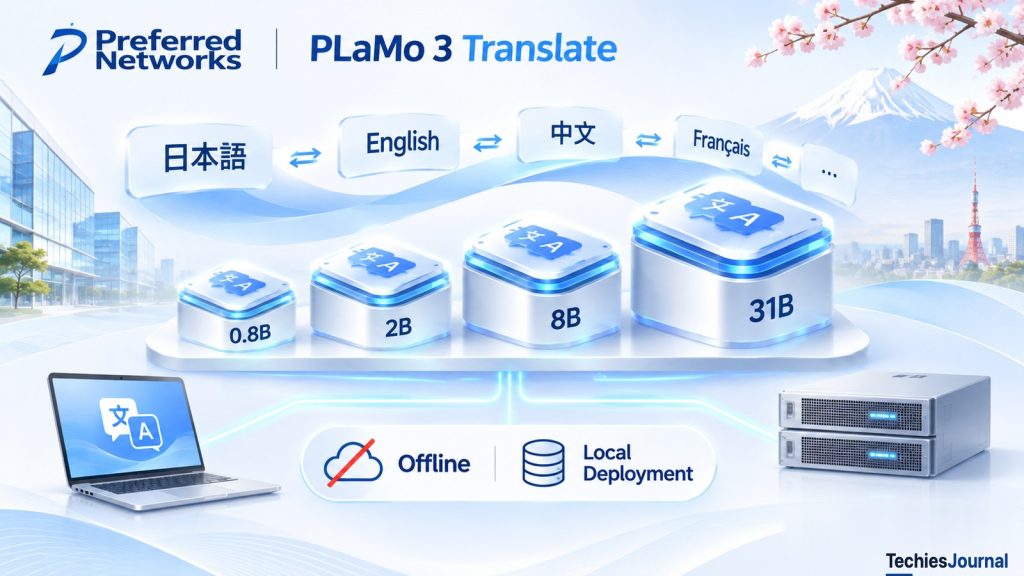
Preferred Networks released four translation models with downloadable weights, from 0.8B to 31B parameters, for 53 supported languages. Commercial use requires registration, and companies above 1 billion yen in revenue need a separate licence.
The question this article answers
Can a developer or a company run PLaMo 3 Translate offline for its own translation work, under what licence terms, on what hardware, and how far can PFN’s quality claims be trusted? The answers below come from Preferred Networks’ pages and its model cards, and every figure is attributed to the page it comes from.
What was released
Japan-based Preferred Networks (PFN) announced PLaMo 3 Translate on November 5, 2026. PFN’s news release calls it an open-weight release of translation-specialised large language models, built on PLaMo 3 NICT, a pretrained model from PFN’s joint research with Japan’s National Institute of Information and Communications Technology. “Open-weight” is PFN’s term. It means the weights can be downloaded, and the licence below limits how they may be used. The commit history of the 8B repository shows the weights on Hugging Face on November 4 (UTC) and a licence revision on November 9.
| Model repository | Parameters, Hugging Face metadata | BF16 weight files | GGUF Q4_K_M weight files |
|---|---|---|---|
| plamo-3-translate-0.8b | 0.89 billion | 1.78 GB | 0.57 GB |
| plamo-3-translate-2b | 2.88 billion | 5.76 GB | 1.81 GB |
| plamo-3-translate-8b | 8.53 billion | 17.06 GB | 5.28 GB |
| plamo-3-translate-31b | 31.76 billion | 63.51 GB | 19.53 GB |
Source: the PFN model cards, where PFN defines size as “the total size of the weight files”. These are file sizes, not the memory needed to run a model, and the cards give no RAM, VRAM or speed figure. The model names are PFN’s nominal sizes, so the “2B” model has 2.88 billion parameters.
PFN’s news release shows the 0.8B model translating on a smartphone in airplane mode, captioned as running at normal speed in a demo environment. PFN’s technical post says this is an internal demo and that PFN has not released an app like it.
Formats and the hardware they target
PFN’s technical post lists seven formats for each size and the hardware each one targets.
| Format | Target hardware | Inference engine |
|---|---|---|
| BF16 | GPUs with BF16 support | Transformers or vLLM |
| FP8 | NVIDIA Ada Lovelace, Hopper or Blackwell | vLLM |
| W4A16 | NVIDIA Ampere or later | vLLM |
| W4AFP8 | NVIDIA Hopper | vLLM |
| NVFP4 | NVIDIA Blackwell | vLLM |
| GGUF | CPUs and GPUs | llama.cpp |
| MLX-4bit | Apple silicon | mlx-lm |
Source: PFN technical post. By this table, five of the seven formats are NVIDIA GPU formats served with vLLM, and the GGUF and MLX builds are the paths for a laptop or desktop. TechiesJournal’s guide to choosing between Ollama and llama.cpp covers that runtime choice. The model code ships in the repository, and every example on the 8B model card loads it with trust_remote_code=True. Review that code before running it on a company server, and see TechiesJournal’s article on what a team takes on when it runs its own models.
Languages and features
The model cards say each model supports translation among 53 languages. PFN counts Simplified and Traditional Chinese separately, which is why Hugging Face shows 52. PFN’s technical post says its evaluation covers a subset of the supported languages, 15 in all: Arabic, Italian, Indonesian, English, Japanese, Dutch, Korean, Spanish, Thai, Chinese (Simplified and Traditional), German, French, Vietnamese and Russian. The other 38, for example Hindi and Telugu, are supported, and the post says the model was also trained on them.
PFN’s news release describes translation with surrounding context, glossaries for proper nouns, technical jargon and product names, and a choice of formal or plain Japanese when translating into Japanese.
Licence
| Use | Condition | Source |
|---|---|---|
| Personal, and non-commercial including academic | Free, with no prior registration and no revenue limit | Model card |
| Commercial, user and affiliates at or below 1 billion yen in revenue or sales | Prior registration with PFN | Licence, Article 3 |
| Commercial, above 1 billion yen | A separate licence agreement with PFN | Model card |
The PLaMo Community License defines commercial purpose as any use beyond personal or academic use, including use within the user’s own organisation and through hosting services or APIs. Internal business use therefore counts. When a model or a derived model is provided to third parties, the licence requires a copy of the licence, a “Built with PLaMo” notice and “PLaMo” in the model’s name. The text was revised on November 9, 2026. It now says translated output may be shared without a model notice, except that a book, paper or similar long publication must state that PLaMo was used for translation. PFN’s news release carries a correction notice dated November 5, so rely on the licence text and not the announcement. Read the licence for your own situation, because this article is not legal advice.
What PFN reports and how it measured
PFN compared its models with two translation-specialised families, Google’s TranslateGemma (4B, 12B and 27B) and Tencent’s Hy-MT2 (1.8B, 7B and 30B-A3B), in the figure on its model cards. PFN says the 0.8B model beats all of them for Japanese-English and for Japanese to other languages, and that the 2B model does so for English to other languages. It also says its results justify calling PLaMo 3 Translate “the world’s best translation-specialized LLM”.
| Benchmark | Origin | Direction | Metric |
|---|---|---|---|
| PFTB | PFN in-house, references written with several LLMs | Japanese to English and English to Japanese | charsim n-gram similarity |
| SaaS | PFN in-house | English to Japanese only | charsim n-gram similarity |
| WMT24++ | Public | English to Japanese | COMET-22 |
| FLORES+ | Public | Japanese or English with each of 14 other languages | chrF++ |
Source: PFN technical post. PFN says it relied mainly on PFTB and SaaS because WMT24++ is short sentences with reference-quality concerns, and its release figure is captioned “Based on PFN evaluations, including proprietary benchmarks”. These are PFN’s own results. No independent reproduction is cited, and this article has not reproduced them. For how to read such claims, see TechiesJournal’s guide to how to read AI benchmark claims.
PFN says nearly all quantized formats kept nearly the BF16 accuracy. Its own model-card tables show the 2-bit GGUF Q2_K builds losing more. For the 0.8B model, the FLORES+ score for English with other languages falls from 54.44 in BF16 to 51.15 in Q2_K.
What to check before adopting it
- Registration: a business using the models for internal work is making commercial use, so confirm the revenue test and register first.
- Privacy: PFN says that when the model runs locally, neither the source text nor the translation is sent to external cloud servers. That covers the model only, and an application around it, for example OCR, logging or telemetry, can still send content elsewhere.
- Length: the model cards give 32,768 tokens as the maximum for input and output together, so split longer documents.
- Your languages: test the exact language pairs, terminology and file formats you translate, especially outside the 15 evaluated languages.
Sources
- Preferred Networks news release, November 5, 2026
- Preferred Networks technical post
- PLaMo 3 Translate 0.8B
- PLaMo 3 Translate 2B
- PLaMo 3 Translate 8B model card
- PLaMo 3 Translate 31B
- PLaMo Community License text
Sources were read on November 12, 2026. Benchmark results are PFN’s own and were not reproduced for this article, and licence terms and repositories can change.