

What a small assignment can teach
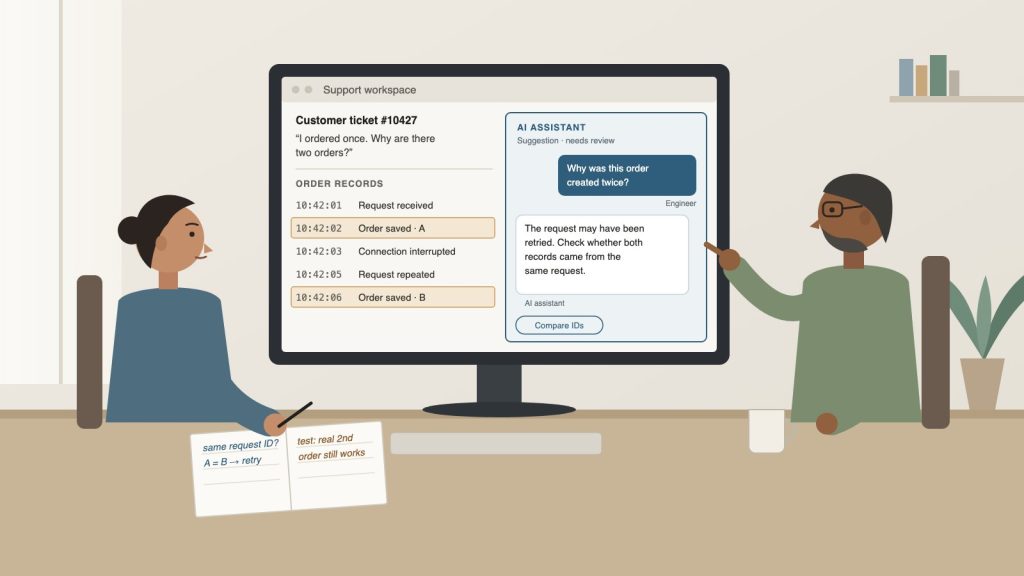
Imagine a customer reporting that the same order sometimes appears twice. A junior engineer receives the ticket. The first question is whether the customer placed two orders or the system processed one request twice.
The engineer checks the records, tries to reproduce the problem and asks a colleague for help. Together, they discover that a request can be repeated when the connection is interrupted. The correction must prevent a duplicate without blocking a genuine new order. Someone must test both possibilities before the change reaches customers.
The visible result is a small correction. Along the way, the engineer has practised gathering evidence, questioning an assumption, explaining uncertainty and deciding when to seek help.
Now suppose AI examines the available records, identifies a likely repeated request, drafts a correction and generates tests before the engineer has worked through the cause. The team may finish sooner. But can the engineer recognise the same problem in a different system, or spot a mistake in the suggested correction?
My position is that an organisation automating work that helped beginners develop should fund the practice, feedback and supervision that replace it. Otherwise, its calculation records the saving but leaves unanswered who will pay for the development the removed work once provided.
One customer problem. What does the engineer learn?
An illustrative duplicate-order investigation compares a proposed AI correction with the engineer’s work to verify the cause, test exceptions and explain the reasoning to a colleague.
- 10:42:01
- Request received
- 10:42:02
- Order saved
- 10:42:03
- Connection interrupted
- 10:42:05
- Request repeated
Engineer investigates
Check whether these requests represent one purchase or two.
Likely cause: a repeated request.Draft correction: recognise a request already processed.
Draft testsRepeated request → one order
Genuine new purchase → another order
Engineer tests and explains
Reproduce the failure. Check that a real second purchase still succeeds.
Colleague reviews the reasoning and the correction
“Show me what caused it, what you tested and what is still uncertain.”
Correction and test results ready for review
A completed work item; the engineer’s understanding has not been assessed in this view.
The question behind the test
Does the test show that a genuine second order still succeeds—or only that duplicates stop appearing?
Finishing is not the same as understanding
Here, understanding means being able to explain the cause, test the proposed solution, identify its limits and apply the reasoning to a new case.
In a small randomised study published in January 2026, Anthropic researchers asked software engineers, mostly junior, to work with an unfamiliar Python library. On a subsequent knowledge test, those given AI assistance scored lower on average than those working without it. The largest gap concerned debugging. The AI group finished slightly faster, but the study could not confidently distinguish that difference from chance.[1]
The study tested understanding shortly afterwards, not competence years later. Still, it raises a practical concern: the completed work may tell a manager less about the employee’s understanding than it once did.
There is evidence in the other direction too. A study of customer-support agents found that AI assistance improved productivity, particularly for less experienced workers. Researchers also found evidence of learning: improvements persisted during interruptions when AI suggestions were unavailable.[2]
The studies examined different jobs and tools. In our engineer’s case, the question is what happens after AI supplies the correction. Does the engineer investigate why it works and where it might fail before submitting it?
| Study | What researchers found | What this does not establish |
|---|---|---|
| Learning an unfamiliar programming library: 52 software engineers, mostly junior. Anthropic, January 2026. [1] | Average knowledge-test scores were 50% with AI assistance and 67% without it. The difference in completion time was not statistically significant. | A small, immediate assessment does not establish long-term professional competence. |
| AI assistance for 5,172 customer-support agents. Published study, 2025. [2] | 15% more issues resolved per hour on average, with larger benefits for less experienced workers. Improvements during AI interruptions provided evidence consistent with learning. | Results from one workplace do not show that every AI tool or working arrangement improves learning. |
| Employment among workers aged 22–25 in highly AI-exposed occupations. Stanford update, August 2026. [4] | By June 2026, employment was about 19% below where it would have been had it kept pace with less-exposed peers of the same age. | This is a relative employment gap, not proof that AI caused a 19% loss of all junior jobs. It does not directly measure learning. |
Doing everything manually is no guarantee of learning either. Repeating a task without feedback can remain repetition. We should preserve the opportunities to investigate, understand and take responsibility, while improving how the work gets done.
What education can prepare us for
The engineer has already begun learning how to question a result through education and earlier practice. Education should strengthen that ability by teaching how the subject works, what counts as evidence and how to recognise a weak explanation. Learning to use AI should build on those foundations.
Assessment should make understanding visible. For our example, a learner could explain why the duplicate appeared, show when a proposed correction fails and defend a different approach. A polished submission alone would leave those questions unanswered.
A university can simulate this incident and assess the response. Responsibility for changing a live system used by real customers adds consequences that a classroom exercise cannot fully reproduce. Employers should help educators provide realistic projects and paid placements, then continue development through supervised work. Expecting graduates to arrive ready for complex responsibility while withdrawing opportunities to practise creates a problem that another certificate cannot necessarily solve.
The World Economic Forum’s 2026 framework, developed with PwC, looks at how people enter work, what their jobs involve, how they develop and how education prepares them.[3] Educators and employers need to agree on who provides which experience, who supervises it and how they will check what people have learned.
Who benefits—and who pays for learning?
Return to the team handling duplicate orders. Suppose an experienced engineer using AI can now resolve work that previously involved a junior colleague. There is a business reason to consider that change. There is also a funding decision inside it.
Higher output does not determine who benefits. The gain could support more automation, higher wages, lower prices, profits or returns to owners. It could also fund paid practice, supervision and protected learning time when the removed work helped people develop.
Suppose the team retains the junior engineer but expects an experienced colleague to teach them alongside an unchanged workload. It has named a mentor without allowing time for mentoring. The plan must set aside working time for teaching and practice, as well as money for tools.
If an employer expects people to acquire the same experience elsewhere, someone else must provide and fund it. That might be another employer, a college, a public programme or the learner. Requiring unpaid preparation would also raise a question about who can afford to enter.
Training costs money, and a trained employee may leave. A credible training proposal must acknowledge that. Buying tools and recruiting experienced people also cost money. The comparison should include how the organisation will sustain the skills it expects to need.
Where will the next experienced employee come from?
But funding practice only helps if people have an opportunity to enter the profession in the first place. The question of training therefore becomes a question of hiring.
Stanford researchers using payroll data from ADP reported that, by June 2026, employment among workers aged 22–25 in highly AI-exposed occupations was below where it would have been had it kept pace with similarly aged workers in less-exposed occupations (see the employment row in the evidence table). Their analysis suggests that the change mainly reflects fewer young workers being hired, rather than an increase in workers leaving their jobs.[4]
The findings show a difference in employment; they do not establish how much of it AI caused. The study also groups workers by age, which does not necessarily tell us how experienced they are.
Nor does the finding prove a future shortage of leaders. That remains a risk to consider. If fewer people enter a profession, or those who enter receive less useful practice, organisations need to examine how their future recruitment and promotion plans will work.
Hiring experienced people trained elsewhere may be reasonable for an individual organisation. The harder question arises if many employers expect others to provide that training. Where will the experience come from, and who will have access to earning it?
What must remain when the task changes
Our junior engineer can use AI and still learn from the duplicate-order problem. Ask them to investigate the cause, explain the suggested correction and test whether a legitimate second order still succeeds. Have an experienced colleague review the reasoning as well as the code. Over time, give the engineer more responsibility as they demonstrate understanding.
That requires time from both people. A manager cannot ask for careful development while rewarding only the fastest closure of tickets. Experienced colleagues also have to accept that guiding someone may take longer than finishing the work themselves.
For each substantial change to junior work, I would ask the employer to identify what people previously learned, where they will practise it now, who will guide them and how that person’s time will be funded. Educators should help prepare learners for those assignments. Learners should be expected to explain and question the work they submit, including work produced with AI.
The customer needs the duplicate order fixed. The business also needs someone who can investigate the next unfamiliar failure. An automation decision should account for both.
Sources and evidence
Sources reviewed on 27 September 2026. The opening situation is illustrative, not a report of a particular project. Recommendations and possible future consequences are the author’s interpretation; the studies below do not establish a long-term shortage of professionals.
- Anthropic — “How AI assistance impacts the formation of coding skills,” 29 January 2026. A small randomised experiment measuring immediate understanding of an unfamiliar programming library. It does not establish long-term career effects. ↩
- Erik Brynjolfsson, Danielle Li and Lindsey Raymond — “Generative AI at Work,” The Quarterly Journal of Economics, May 2025. A study of 5,172 customer-support agents, including evidence consistent with learning during AI use. Findings come from one workplace setting. ↩
- World Economic Forum, in collaboration with PwC — “Artificial Intelligence and the Future of Entry-Level Work: A Framework for Safeguarding and Reinventing Early Career Pathways,” 22 June 2026. A framework connecting job access, job design, talent development and education. It provides recommendations rather than proof that a particular training programme works. ↩
- Erik Brynjolfsson, Bharat Chandar and Ruyu Chen — “No Widespread Displacement, but the AI Employment Gap for Young Workers Has Widened to 19%,” Stanford Digital Economy Lab, 12 August 2026. The authors’ summary of revised employment research through June 2026. It explains the relative gap, analytical limitations and why the findings should not be treated as causal estimates. ↩