
Is this a new engineering career, or an old job with a new title?
A software company builds an AI system that can process thousands of documents. The demonstration works, and a bank decides to use it.
But the bank’s documents are spread across several systems. Customer information must remain protected, existing approval processes cannot be bypassed, and the AI system needs to work with the bank’s software.
The product works. Making it work inside the bank is another problem.
This is where a Forward Deployed Engineer (FDE) comes in.
What is a Forward Deployed Engineer?
Forward deployed is a phrase used in military settings for personnel positioned closer to an operational area. The software role borrows that idea of working close to where the problems arise; it is not a military job.
Palantir helped popularise the FDE title in technology. A long-serving Palantir FDE describes the approach as working closely with customers, taking responsibility for outcomes, and using lessons from deployments to improve the core product.
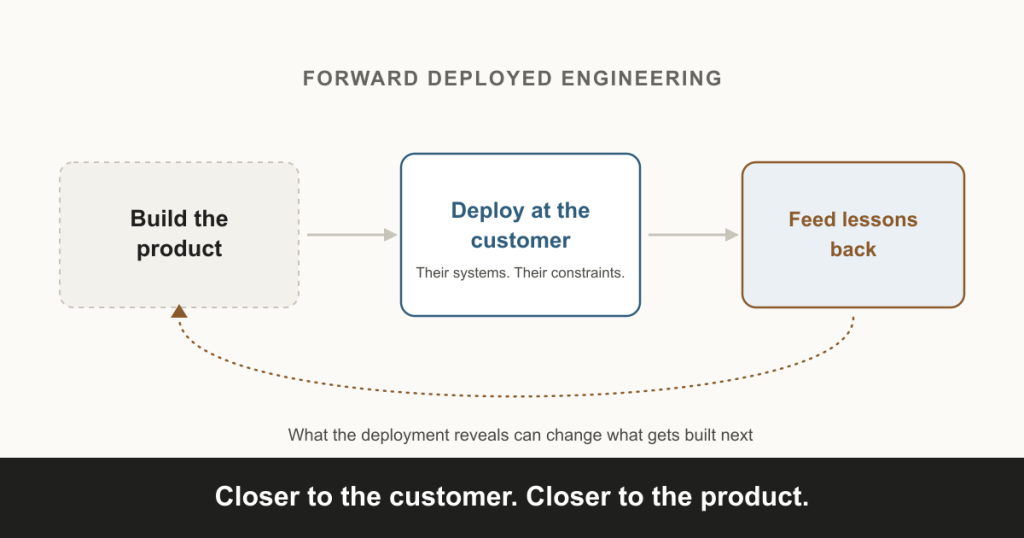
An FDE follows that principle: understand a customer’s problem, build the required solution, deploy it, and learn from how it performs.
The work, at a glance
- Understand the problem. Learn the customer’s real constraints, not just the demo scenario.
- Build and integrate. Connect the system to what the customer already runs.
- Deploy and support. Ship it, keep it running, and resolve what breaks in production.
- Feed lessons into the product. What the deployment reveals can change what gets built next.
Step 4 feeds back into step 1: problems discovered during one deployment can shape what the engineer builds for the next customer.
In our banking example, the engineer might connect the AI system to existing databases, develop APIs, implement security controls, test the system and resolve production issues. Problems discovered during deployment can also influence future product development.
Why are companies hiring FDEs now?
Enterprise AI has made the gap between a successful demonstration and a working business system more visible. An AI model may perform well in a controlled test but still need considerable engineering before an organisation can use it safely and reliably.
Companies need engineers who understand both the technology and the environment in which customers use it. For example, OpenAI’s FDE job description covers customer discovery, system design, building software, production rollout and feedback that influences its products and models.
This shows a real need at particular employers, not evidence that most recruiters are hiring FDEs. Technical consultants, implementation engineers and Solutions Engineers have performed related work for years. The emphasis here is on combining hands-on engineering, customer involvement and delivery responsibility in one role.
Forward Deployed Engineer vs. Solutions Engineer
| Solutions Engineer | Forward Deployed Engineer |
|---|---|
| Often helps customers evaluate a product and choose a technical approach. | Often builds and deploys a solution in the customer’s environment. |
| May focus on discovery, demonstrations and architecture. | May focus more heavily on coding, integration and production delivery. |
| May support implementation. | Typically has more direct ownership of implementation. |
These are common differences, not fixed rules. Some Solutions Engineers write production code, while some FDEs also work on demonstrations and technical discovery. Compare the responsibilities in OpenAI’s Solutions Engineer description with its FDE description: the job description matters more than the title.
What skills do you need?
An FDE needs more than the ability to write code. The work may draw on software development, APIs, databases, cloud infrastructure, debugging and security. AI-related positions can also require experience deploying language-model applications and understanding their limitations.
Communication matters too: the engineer must discover the real business problem, explain trade-offs and work with people outside engineering.
There is no universal eligibility rule. OpenAI’s Seattle posting, for example, asks for five or more years of engineering or technical deployment experience, including customer-facing work. That is one employer’s requirement, not an industry-wide minimum. A particular degree is not specified in that posting. Students can build the foundations through engineering projects, while experienced developers, cloud engineers and Solutions Engineers may already have relevant experience. Source: OpenAI FDE posting.
Is it a career opportunity or just another title?
An FDE position can offer challenging engineering problems, direct customer involvement and ownership of production outcomes. It may also mean changing customer requirements, less time on the core product and travel: OpenAI’s Seattle posting specifies travel of up to 50%. That condition is specific to the posting, not every FDE job.
Before considering a position, check what you would actually own:
- Will I write and maintain production code?
- Will I own deployment outcomes?
- Will customer feedback influence the product?
If the work is mainly demonstrations, configuration or support, it may overlap substantially with an existing Solutions Engineer or implementation role.
Forward Deployed Engineering is not entirely new work. The useful question is whether a particular job gives an engineer meaningful responsibility for turning a customer’s problem into software that works in practice.
References and further reading
- Palantir Developer Community — Who are Palantir FDEs? A Palantir engineer’s account of the approach and its connection to product development (July 15, 2026). This is a practitioner’s explanation, not independent historical proof of who invented the title.
- OpenAI — Forward Deployed Engineer, Seattle. Direct evidence of one employer’s responsibilities, experience requirements and travel expectations (reviewed September 19, 2026).
- OpenAI — Solutions Engineer, Financial Services (archived copy). A real role description for comparing the emphasis of Solutions Engineering with FDE work. The original posting was removed from openai.com after this article’s first source review; this link is an archived snapshot (Wayback Machine, February 10, 2026) confirmed to match the description compared above.
Source review: September 19, 2026. Job descriptions may change — the OpenAI Solutions Engineer posting above was confirmed live in an earlier review and has since been taken down; see the References note. The bank example is illustrative, not a report of a real deployment.