

The Job Title Stayed. The Work Changed.
Imagine a cloud administrator called Arun.
A few years ago, much of his work arrived through tickets: create a virtual machine, add storage, update a firewall rule, or give a user access. Today, a self-service portal or an infrastructure-as-code pipeline may handle those requests.
At first, that can look like job loss. But Arun’s new queue tells a different story. A deployment fails only in production. A team needs temporary access without creating a permanent security risk. Cloud spending rises after a traffic spike. A service meets its uptime target but remains painfully slow for users.
The button-clicking work has reduced. The engineering decisions have not.
This is the main shift in cloud careers: organisations need fewer people whose only value is operating a console, but they still need people who can design, automate, secure, observe, troubleshoot, and improve cloud systems.
Automation Removes Steps, Not Accountability
Cloud platforms were built to automate infrastructure. Infrastructure as code extended that idea. CI/CD pipelines automated delivery. Managed services reduced the work required to operate databases, clusters, and messaging systems.
These changes remove manual steps such as:
- repeatedly creating similar resources;
- applying the same configuration by hand;
- copying deployment commands between environments;
- checking dashboards one screen at a time; and
- producing routine inventory and cost reports.
That is good engineering. Repetitive work is slow, inconsistent, and difficult to audit.
But automation does not decide what the organisation should standardise. It does not know which failure mode the business can tolerate, whether an access policy is too broad, or when a cheaper design creates unacceptable operational risk. Someone must create the automation, set its guardrails, measure its results, and respond when reality does not match the plan.
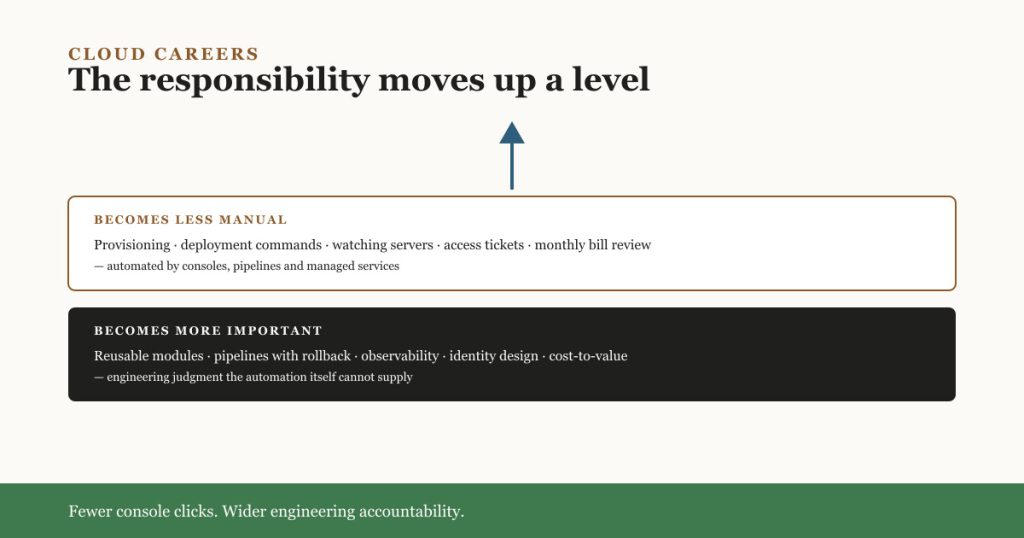
The responsibility moves up a level.
| Work that becomes less manual | Responsibility that becomes more important |
|---|---|
| Provisioning resources in a console | Designing reusable infrastructure modules and safe defaults |
| Running deployment commands | Building delivery pipelines with tests, approvals, and rollback paths |
| Watching individual servers | Observing services through metrics, logs, traces, and user impact |
| Granting access ticket by ticket | Designing identity, least privilege, and auditable access workflows |
| Reviewing a monthly cloud bill | Connecting architecture and usage decisions to cost and business value |
One Cloud System, Several Engineering Lenses
Titles such as cloud engineer, platform engineer, site reliability engineer, and DevSecOps engineer often overlap. They are not a universal career ladder, and companies use them differently.
A useful way to understand them is by the question each role emphasises:
- A cloud engineer asks whether the infrastructure and managed services fit the workload.
- A platform engineer asks whether teams can use shared capabilities safely without learning every internal detail.
- A site reliability engineer asks whether the service can meet reliability goals and recover from failure.
- A DevSecOps engineer asks whether delivery and operations include security controls early and continuously.
In a small organisation, one person may wear all four hats. In a large organisation, separate teams may own them. The boundaries matter less than the outcomes: repeatable delivery, secure access, observable systems, controlled cost, and reliable service.
DORA describes a platform as shared capabilities that improve software delivery efficiency and productivity. Its guidance also recommends measuring platform work through delivery outcomes—not merely counting how many tools or templates a platform team creates. That distinction is important. A portal nobody trusts is not a successful platform.
The Five Responsibilities Expanding Around Cloud Work
1. Infrastructure must become software
Knowing a cloud console is still useful for exploration and diagnosis. It is not enough for repeatable production work.
Engineers increasingly need to read and change infrastructure definitions, review them like application code, test important assumptions, and understand state and drift. The objective is not to memorise every Terraform, OpenTofu, Bicep, or CloudFormation feature. It is to make changes reproducible and reviewable.
2. Delivery and operations are connected
A resource is not valuable merely because it exists. Applications must reach it safely and repeatedly.
That brings cloud work closer to source control, build systems, deployment strategies, secrets management, and rollback. An engineer does not need to become an expert application developer, but should understand how a code change travels from a repository to a running service—and where that journey can fail.
3. Reliability is a design concern
Traditional monitoring often asked, “Is the server up?” Modern operations must ask, “Can users complete the action they came to perform?”
That requires useful service indicators, clear alerts, capacity awareness, tested recovery procedures, and honest incident reviews. DORA’s delivery measures similarly connect speed with stability: frequent delivery is not success if changes repeatedly fail or take too long to recover.
4. Security belongs in everyday engineering
Cloud security is not a final approval added after deployment. Identity, network exposure, secrets, software dependencies, logging, encryption, and policy are part of the system’s design.
NIST’s NICE Framework reflects this breadth by organising cybersecurity work across governance, design and development, implementation and operation, protection, and investigation. A cloud professional need not become a penetration tester, but cannot treat security as somebody else’s queue.
5. Cost is an operational signal
Cloud systems turn technical choices into recurring spending. Oversized resources, forgotten environments, inefficient data movement, and badly chosen pricing models can quietly become architecture problems.
The FinOps Foundation describes engineers as participants who use cost and usage information alongside resilience and availability data when making decisions. That does not make every engineer an accountant. It means cost becomes another system signal—like latency, error rate, or capacity.
Does Everyone Need to Learn AI Now?
No.
AI workloads may introduce GPU scheduling, model endpoints, vector databases, data governance, and unpredictable consumption. Cloud teams supporting those workloads should understand their operational characteristics.
But the underlying responsibilities remain familiar: capacity, identity, networking, observability, reliability, security, and cost. A cloud engineer does not need to become a data scientist simply because one application calls a model.
AI-assisted tools may also generate templates, queries, pipeline steps, or troubleshooting suggestions. They can reduce time spent on first drafts. They do not remove the need to validate permissions, failure behaviour, production impact, and cost. Generated infrastructure can fail at machine speed too.
Treat AI as one workload and one tool—not as the definition of a modern cloud career.
A Practical Way to Broaden Without Learning Everything
Trying to master every cloud service, programming language, security product, and platform tool is a reliable path to shallow knowledge and exhaustion.
Use three levels instead:
Know
Understand the concepts that affect every cloud system: identity, networking, compute, storage, availability, monitoring, security boundaries, and cost. You should be able to discuss trade-offs even when you are not the person implementing them.
Use
Build working ability in one practical toolchain. For example: one cloud provider, Git, an infrastructure-as-code tool, a CI/CD system, containers, and an observability stack. The exact products matter less than being able to connect them into a repeatable workflow.
Master
Choose one area where colleagues can rely on your judgment. It might be Kubernetes operations, cloud networking, identity, reliability engineering, platform design, or cost optimisation. Depth creates professional value; breadth helps that depth work with the rest of the system.
Then prove the combination with a small project. Deploy a service through a pipeline. Define its infrastructure as code. Add least-privilege access, useful telemetry, a budget alert, and a tested rollback. Document one failure and what you changed afterward.
That demonstration says more than a long list of services on a résumé.
What the Employment Data Can—and Cannot—Tell Us
There is no clean government category called “cloud engineer,” so precise claims about the disappearance of cloud roles should be treated carefully. Job titles vary too much between employers.
The broader indicators do not show technology work vanishing. Current U.S. Bureau of Labor Statistics projections show faster-than-average growth for several occupations surrounding cloud systems, including software development, network architecture, information security, and computer and information systems management.
Those figures do not guarantee that every current title or task will remain unchanged. They show why “cloud jobs are dying” is too simple. Demand can grow while the skills inside a role change, and while entry-level or highly repetitive tasks face more automation.
The Better Career Question
Do not build a career around access to a particular console. Build it around an operational outcome.
Can you make infrastructure repeatable? Can you help teams deliver safely? Can you explain why a service failed? Can you reduce risk without stopping delivery? Can you connect cost to an architectural decision? Can you make the next incident less likely?
Cloud roles are becoming broader because cloud systems now sit inside the full software lifecycle. That change can feel uncomfortable, especially when familiar tasks disappear. But it also creates a clearer path forward.
Keep the fundamentals. Automate the repetition. Add one adjacent responsibility at a time. Develop deep judgment somewhere that matters.
The durable role is not the person who knows where every button is. It is the engineer who understands what should happen after the button is pressed—and what to do when it does not.
Go deeper
- Occupational Outlook Handbook: Computer and Information Technology — U.S. Bureau of Labor Statistics. Employment projections for software development, network architecture and related occupations.
- Occupational Outlook Handbook: Computer and Information Systems Managers — U.S. Bureau of Labor Statistics. Job outlook for technology management roles.
- Platform Engineering capability — DORA (Google Cloud). How platform capabilities should support application teams.
- DORA Metrics guide — DORA (Google Cloud). How to measure software delivery performance through outcomes, not output.
- Engineering Persona — FinOps Foundation. How engineers use cost and usage data in architecture and operations decisions.
- FinOps Personas — FinOps Foundation. How engineering, finance, product and leadership collaborate on cloud cost decisions.
- NICE Workforce Framework for Cybersecurity — NIST. How cybersecurity responsibilities span multiple work categories, not one job title.