
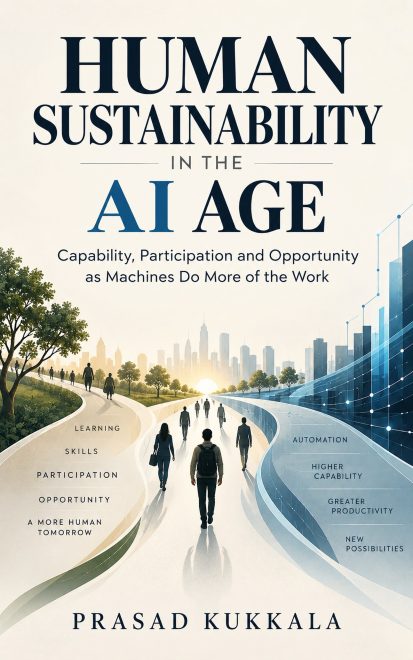
Artificial intelligence is getting better at work that once needed human attention, judgement and language. What has to keep working for people while that happens?
This book does not predict that work will disappear, and it does not promise that technology will automatically create better jobs. It asks a more useful question: as AI and robotics take over more cognitive and physical work, how do people keep developing capability, participating in the economy, finding opportunity and contributing something that matters?
Drawing on labour statistics, economic research and education evidence, Human Sustainability in the AI Age separates what the data shows from what the headlines claim. It follows the change from tasks to workflows to entry-level jobs and skills; it looks at the other side of the story, where AI lets one person or a small organisation do far more; it asks what happens to learning, judgement and expertise when machines can supply the answers; and it follows productivity into wages, prices, ownership and public finance.
Three distinctions run through every chapter:
- Capability is not deployment.
- Task automation is not job elimination.
- Better performance with AI is not automatically stronger capability without it.
Rather than one forecast, the final part tests these ideas against several plausible futures, from AI progress slowing to machines advancing far faster than institutions can adapt, and asks what individuals, employers, educators and governments can do now without pretending to know where the technology will stop.
Who it is for: professionals deciding what to learn next, managers redesigning work, educators and parents, policymakers, and anyone who wants an evidence-based view of AI’s effect on people rather than a hype cycle or a doom story.
Illustrated with 66 figures and referenced to OECD, ILO, World Bank, IMF, BLS and peer-reviewed sources, with a dated note on the evidence so readers know what was known when.
Human Sustainability in the AI Age is available exclusively on Kindle. Read the Introduction below, then continue on Amazon in your own country’s Kindle store.