

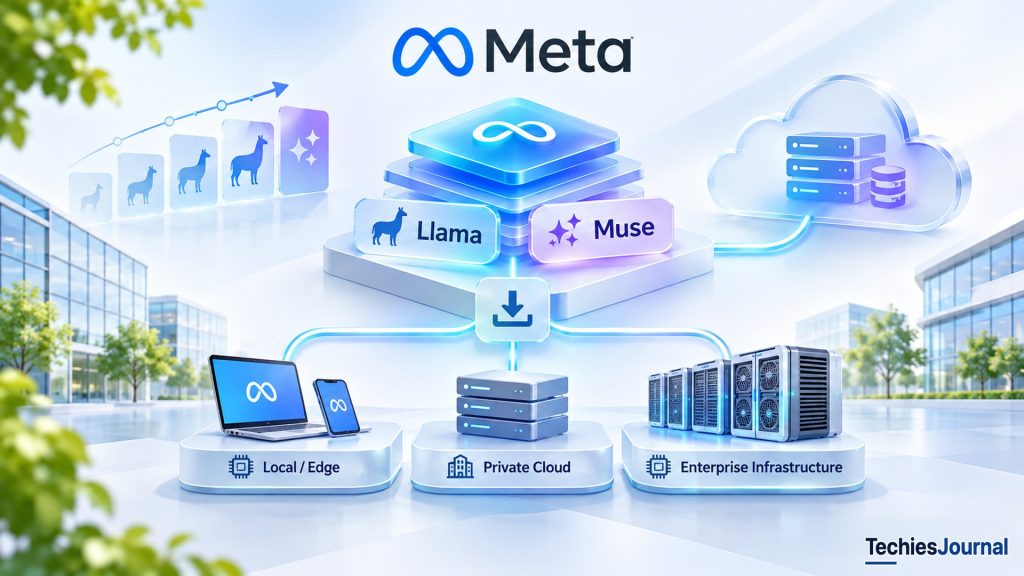
Meta has played a significant role in changing how artificial intelligence models reach developers and enterprises. While several leading AI companies primarily provide access to their models through hosted services, Meta made trained model weights available for others to download, customize and operate on their own infrastructure.
The Llama family helped establish this approach. Developers gained opportunities to experiment with large language models, adapt them for specialized applications and build AI systems without relying exclusively on a model provider’s API.
With the introduction of the Muse family, Meta’s strategy is evolving. Its portfolio now includes advanced hosted intelligence, downloadable frontier models and smaller models designed for local AI agents. These models are being released under different licensing arrangements, creating new opportunities alongside important technical and commercial considerations.
Understanding this evolution helps explain what model ownership means in practice, how Meta competes with other AI providers and whether self-hosted intelligence is becoming a realistic alternative for developers and enterprises.
From Llama to Muse: how Meta’s AI strategy evolved
When Meta introduced LLaMA in February 2023, its importance extended beyond benchmark performance. Researchers could obtain trained weights and investigate the model’s capabilities without interacting exclusively through a commercial API. Llama 2 broadened access to commercial applications under its own licensing conditions. The Llama 3 generation added larger models, multilingual capabilities, compact variants and multimodal processing. By April 2025, Llama 4 introduced sparse expert architectures through Scout and Maverick.
The Muse family represents another transition. Meta introduced proprietary frontier intelligence and subsequently released models for independent deployment. In August 2026, Muse Glimmer brought a 30-billion-parameter agent model to developers under Apache 2.0. In October, Muse Spark Open extended downloadable intelligence to an 816-billion-parameter frontier-scale model. The newer hosted Wonder and Ember models address other parts of the capability and efficiency spectrum.
Meta’s model registry and Glimmer research announcement document these different paths. The significance is that Meta now offers both independently operated and provider-managed intelligence. It is not following one uniform licensing or deployment strategy.
Text version of Figure 1
- February 2023: LLaMA, trained weights for researchers.
- Llama 2: broader commercial access under its own license.
- Llama 3 generation: larger, multilingual, compact and multimodal models.
- April 2025: Llama 4 Scout and Maverick, sparse expert models.
- August and October 2026: Muse Glimmer and Muse Spark Open are downloadable, Wonder and Ember are hosted.
Understanding Meta’s model ecosystem
The Llama family remains relevant because downloadable checkpoints can remain usable after newer generations arrive. Muse extends that portfolio with local agent capabilities, frontier reasoning and specialized hosted services. The principal models are shown below. This is a selected inventory, not a count of all supported versions.
| Model | Total parameters | Context | Intended use / availability |
|---|---|---|---|
| Llama 3.1 | 8B / 70B / 405B | 128K | Downloadable text models |
| Llama 3.2 | 1B / 3B | 128K | Compact text processing |
| Llama 3.2 Vision | 11B / 90B | 128K | Image and text understanding |
| Llama 3.3 | 70B | 128K | Downloadable multilingual text model |
| Llama 4 Scout | 109B | 10M | Multimodal, sparse experts |
| Llama 4 Maverick | 400B | 1M | Multimodal, sparse experts |
| Muse Glimmer | 30B | 128K by default | Downloadable dense model for local agents, text and image input |
| Muse Spark Open | 816B | 1,048,576 | Downloadable multimodal input, text output |
| Muse Spark | Not stated | Version dependent | Hosted agentic and coding model |
| Muse Wonder and Wonder Full | Not stated | Version dependent | Hosted frontier coding and long-running agents |
| Muse Ember | Not stated | Version dependent | Hosted efficient multimodal model for everyday coding and agent work |
Sources: Llama registry, Spark Open specifications, Glimmer documentation, Meta developer platform and Artificial Analysis. Hosted model access, version names and service support must be checked for the intended region and account. A maximum context length is not a promise that a given deployment can efficiently process that many tokens.
Meta also develops media intelligence. The primary focus here is its language, multimodal input and agent models. The portfolio illustrates a direction we also examined in our Microsoft model article: different types of intelligence can coexist within the same application. A model used for routine tool calls does not necessarily need the same capabilities as one investigating a difficult software failure.
What makes Meta’s models technically different?
From dense models to sparse intelligence
The numerical values learned during model training are called parameters. These values influence how the model processes an input and produces an output. In a conventional dense transformer, most of the core network participates in the computation for each token. Larger dense models generally need more memory and computational resources, although model size alone does not establish capability.
An alternative is to divide portions of the network into expert subnetworks. A learned router selects some of these experts for a particular token, and their contributions are combined for further processing. This is called a Mixture of Experts (MoE). The experts are numerical networks, not separate human-like assistants with fixed professions.
Llama 4 Scout contains 109 billion parameters with 17 billion active, while Maverick has 400 billion with 17 billion active. Muse Spark Open extends the architecture to 816 billion parameters with 42 billion active. It accepts text, image, audio and video inputs and generates text.
Text version of Figure 2
- A learned router selects some experts for each token and combines their outputs.
- Llama 4 Scout: 17 billion active of 109 billion total, about 15.6 percent.
- Llama 4 Maverick: 17 billion active of 400 billion total, about 4.3 percent.
- Muse Spark Open: 42 billion active of 816 billion total, about 5.1 percent.
- The full weight set must remain accessible, so the active share does not give memory or energy use.
Spark Open activates approximately 5.1% of its total parameters per token. That calculation is not an estimate of memory consumption or energy savings. The full weight set must remain accessible, potentially across multiple accelerators. Expert routing and communication between devices also introduce overhead. A model with 42 billion active parameters is not equivalent to a dense 42-billion-parameter model when determining hardware requirements.
Teaching smaller models to perform useful work
Muse Glimmer approaches efficiency from another direction. Instead of trying to bring the full infrastructure requirements of a frontier model to a personal computer, Meta developed a 30-billion-parameter model optimized for local agent workflows. Glimmer is a dense decoder-only model with a built-in vision encoder: it accepts text and image input, produces text and has a default context of 128K tokens. Its training announcement describes learning from Muse Spark during pre-training, longer-context agent training and further fine-tuning and reinforcement learning. Distillation allows a student model to learn aspects of another model’s behavior. It does not guarantee that every capability of the teacher is preserved.
Text version of Figure 3
- Step 1: Muse Spark teaches during pre-training.
- Step 2: longer-context agent training.
- Step 3: fine-tuning and reinforcement learning.
- Step 4: Muse Glimmer, 30 billion parameters, with a drafter for speculative decoding.
- Distillation does not guarantee that every capability of the teacher is preserved.
Meta also describes speculative decoding: a lightweight drafter proposes blocks of tokens that the main model verifies. This aims to improve generation speed while preserving the main model’s output behavior. The drafter itself requires memory and compatible runtime support.
A smaller model can be useful for interacting with application tools, organizing information or making routine code changes. The relevant question is whether the model reliably completes those specific tasks. Its suitability for a local agent does not imply comparable performance across every demanding scientific or reasoning evaluation.
Open weights versus open-source AI
A downloadable model gives developers access to trained numerical weights. It does not necessarily grant access to every part of the training system or unlimited permission to use and redistribute it. A complete AI system may involve architecture and inference software, training and data-processing code, and information about the data used to create the model.
Text version of Figure 4
- Trained weights: included in a download.
- Inference software: not implied by a download.
- Training code: not implied by a download.
- Information about the data: not implied by a download.
- The license decides what use and redistribution are permitted.
The Open Source Initiative distinguishes broader freedoms to use, study, modify and share AI systems from simply obtaining weights. In a February 2025 opinion, it argued that Meta’s Llama license is still not open source. Apache 2.0 makes Glimmer’s released artifacts more permissive than Llama’s custom licenses, but that alone does not establish that the complete training system meets the Open Source AI Definition.
How Meta’s licensing strategy is changing
| Condition | Llama 4 | Muse Glimmer | Muse Spark Open |
|---|---|---|---|
| License | Llama 4 Community License | Apache 2.0 | Muse Model License |
| Downloadable weights | Yes | Yes | Yes |
| Commercial use | Subject to terms | Permitted under license | Subject to terms |
| Modification and redistribution | Conditional | Permitted under license | Conditional |
| Special business threshold | Over 700M monthly active users on the release date | No equivalent clause | Model-as-a-service business above US$20M aggregate gross revenue |
| Custom use restrictions | Yes, acceptable use policy | No equivalent Apache 2.0 conditions | Yes, usage policy |
Sources: Llama 4 license, Llama 4 use policy, Glimmer announcement, Muse Spark Open license.
The Muse Model License introduces a particularly important commercial condition. Businesses providing third parties with access to AI models as a service face a separate written-agreement requirement when aggregate gross revenue of the licensee and its affiliates exceeds US$20 million in a consecutive twelve-month period. The clause relates to offering the licensed model or derivatives through that business. Internal use, research and non-model-as-a-service commercial activities are expressly excepted. The license also requires the notice “Built with Muse Spark Open” in products or accompanying documentation and compliance with its usage policy. It is not a blanket ban on every large enterprise using the model internally.
Llama 4 has its own business threshold, a “Built with Llama” display requirement and, in its acceptable use policy, a clause that withholds the license grant for multimodal models from individuals domiciled and companies based in the European Union. Neither these conditions nor the Muse commercial threshold can be generalized across every Meta checkpoint. Organizations should examine the exact license and acceptable-use policy for the model and activity they intend to undertake. A model being downloadable is not equivalent to unrestricted commercial permission.
Can Meta’s models realistically run on your own infrastructure?
Operating an AI model requires memory for its weights, intermediate computations and the information it retains about the current input. A 30-billion-parameter model represented at 16 bits requires approximately 60 GB for weights alone (Meta’s Glimmer announcement says over 55 GB at full precision). Quantization represents learned values at lower precision and can reduce storage and memory requirements, potentially affecting accuracy and hardware compatibility.
Text version of Figure 5
- 16 bits: 60 GB.
- 8 bits: 30 GB.
- 4 bits: 15 GB.
- Raw weights only, before metadata, higher precision components, the key-value cache and runtime overhead.
16 bits
30 billion parameters times 16 bits, divided by 8 bits per byte, is 60 GB.
Meta’s announcement puts the full-precision size at over 55 GB. It is weights only.
8 bits
30 billion parameters times 8 bits, divided by 8, is 30 GB.
Half the 16-bit figure. Accuracy can change and hardware support decides whether the saving is realized.
4 bits
30 billion parameters times 4 bits, divided by 8, is 15 GB.
Meta reports under 20 GB for the quantized language model, because some components stay at higher precision. It reports a 24 GB or 32 GB envelope for the model, cache, image encoder and drafter together.
The theoretical raw weight calculation is only a starting point. Actual model packages include overhead and may retain some components at higher precision. The key-value cache, which stores information from earlier tokens, grows with the sequence and can become especially important for long-context models. Concurrent requests increase the serving requirements further.
Meta provides actual deployment figures that illustrate these differences.
| Configuration | Published weight footprint | Documented hardware or memory note |
|---|---|---|
| Muse Glimmer, full precision | Over 55 GB | Meta gives no serving budget for this size |
| Muse Glimmer, quantized (17 GB K-Quant variant) | Language model under 20 GB | One 24 GB or 32 GB envelope holds the model, the KV cache, the image encoder and the drafter |
| Muse Spark Open BF16 | About 1.65 TB | Eight GPUs such as 8 x B300, budget roughly 2 TB of VRAM |
| Muse Spark Open NVFP4 | About 537 GB | One 4-GPU NVIDIA Blackwell node |
Sources: Glimmer research announcement and Spark Open deployment documentation. Serving configurations are examples rather than universal minimum hardware specifications.
Glimmer is intended to bring agent capabilities closer to the device. Spark Open, despite also being downloadable, targets substantial enterprise infrastructure. A four-bit arithmetic estimate for an 816-billion-parameter model is not the same as the size of the published mixed-precision checkpoint. Developers need to check the available artifacts, supported runtime, accelerator memory, bandwidth and required concurrency before procuring hardware.
How competitive are Meta’s AI models?
Model accessibility alone does not establish technical superiority. Artificial Analysis provides a useful independent view through its Intelligence Index v5.0.2, combining nine evaluations across categories such as software engineering, agent operations and difficult reasoning. The index scores below were read on the Artificial Analysis Meta page on November 26, 2026.
| Model and reasoning setting | Intelligence Index | Cost per Index task (USD) |
|---|---|---|
| Muse Wonder Full, max | 50 | Not listed |
| Muse Wonder, max | 44 | Not listed |
| Muse Wonder, high | 41 | 4.56 |
| Muse Ember, max | 36 | 0.14 |
| Muse Ember, xhigh | 34 | 0.12 |
| Muse Spark Open, xhigh | 25 | 2.02 |
| Muse Glimmer, high | 6 | 0.21 |
The measurements are a snapshot, not a permanent ranking. Reasoning settings differ, and the table keeps Meta’s rows apart by setting because a row at one setting is not comparable with a row at another. Cost is weighted benchmark-task expenditure using measured service prices, not the cost of operating the downloadable model on private hardware. A hosted model can perform better than a downloadable alternative without providing the same deployment rights. Ember’s results illustrate why specialized efficiency deserves evaluation even when a more flexible open-weight option exists.
Competition beyond Meta
Open-weight alternatives from DeepSeek, Alibaba, Moonshot AI and Mistral make model choice increasingly diverse. On the same index, Artificial Analysis lists Kimi K3.1 Pro at 47 as the highest-ranked open-weights model among the 54 open-weights models it has evaluated. That is well above Muse Spark Open at 25 and Muse Glimmer at 6. The configurations differ in model size, reasoning settings and serving conditions, so these scores are not a controlled hardware test, and one aggregate index does not establish which model works best for a specific application. A score of 6 says little about whether Glimmer completes a narrow tool-calling task on a laptop, and the index rewards large reasoning configurations. Muse Wonder Full at 50 is a hosted model offered through Meta’s API, so it answers a different procurement question from an open-weight model.
A development team evaluating an AI agent should test tool-call correctness, completed tasks, failure handling and latency on representative workloads. An inexpensive model that repeatedly produces invalid calls may cost more per completed operation than a higher-priced alternative. Equally, a smaller model that handles frequent routine work reliably may be more useful than a frontier model for those operations.
Why does Meta release model weights?
Training advanced AI models requires substantial investment. Sharing trained weights can nevertheless support strategic objectives beyond earning revenue from inference requests. In his July 2024 statement, Mark Zuckerberg emphasized customization, independence from closed platforms and the value of building an ecosystem around openly available AI.
When developers adopt a model, they can create applications, optimize inference runtimes and develop specialized versions. Hardware and cloud providers can support its deployment. These activities potentially extend a model’s reach beyond what its original developer could achieve through a single hosted API.
That is a plausible strategic benefit, not evidence of Meta’s undisclosed financial returns or motives. The newer Muse portfolio shows that openness can be differentiated. Glimmer’s permissive license, Spark Open’s conditional license and proprietary Wonder capabilities offer different relationships between control, accessibility and commercialization.
Where are Meta’s models being used?
Meta reported in March 2025 that Llama had been downloaded more than one billion times, and named Spotify, the startup Fynopsis and an individual developer among those downloads. Spotify has used Llama for customized music and podcast recommendations, according to Meta. Meta’s December 2024 ecosystem post lists IBM watsonx among the partners that distribute Llama beyond Meta’s own services. These examples represent different types of engagement and should not be combined into a single production-adoption number.
Downloads do not identify unique users or active installations, and a vendor’s customer example is not an independent measurement of outcomes. Independent adoption data for the newer Muse models remain limited. Relevant sources include Meta AI research and Meta’s developer platform.
Meta also offers hosted consumer and developer intelligence through its developer platform. Its ecosystem consequently spans model weights, independently managed inference, third-party hosted inference, and proprietary services. Meta’s Spark Open documentation lists partners across cloud catalogues, inference platforms, runtimes and silicon providers. Announced partner participation should not be mistaken for universal live availability in every region.
Self-hosted AI: greater control, greater responsibility
When an organization consumes a hosted API, the provider generally operates the model-serving environment. The organization remains responsible for its application, permitted data sharing and service configuration. When it operates a downloadable model, it assumes additional responsibilities for inference capacity, deployment, monitoring, updates and recovery.
Text version of Figure 6
- Self-hosted: you operate inference capacity, deployment, monitoring, updates and recovery.
- Third-party hosted: a provider runs downloadable weights as a service.
- Meta hosted: Meta operates the model through its developer platform.
- In every case the application, the shared data and the service configuration remain your responsibility.
A model can also be hosted by a third party using downloadable weights. This is an intermediate option that may offer deployment portability without requiring a business to maintain every infrastructure component. The legal rights associated with weights do not automatically determine who operates the resulting service.
| Potential benefit of self-hosting | Associated responsibility |
|---|---|
| Greater data control | Protect inputs, outputs, logs and connected services |
| Customization | Evaluate and maintain adapted models |
| Control of versions | Manage patches, compatibility and upgrades |
| Offline execution | Provide sufficient local capacity |
| Reduced reliance on one inference provider | Maintain runtime and hardware support |
| Potential cost savings | Manage utilization, reliability and operating overhead |
Is self-hosting economically attractive?
Downloadable weights do not necessarily incur a conventional per-token inference fee when operated independently. The infrastructure still has a cost, and specialized commercial license conditions may apply. For an organization that already owns suitable hardware, local inference may have a different marginal cost from renting a dedicated accelerator cluster. Spark Open’s footprint makes this distinction particularly important.
Text version of Figure 7
- Rented GPU, 8 hours a day at US$3 per hour for 30 days: US$720.
- Hosted at US$1 per million tokens: US$360 at 360 million tokens.
- US$720 at 720 million tokens, the parity point.
- US$1,080 at 1,080 million tokens.
- Compute only. The GPU must support the model and process the volume within the provisioned hours.
360 million tokens
At US$1 per million tokens, 360 million tokens cost US$360.
That is half of the US$720 for the rented GPU, so low or irregular demand favors a managed API because there is no idle capacity to pay for.
720 million tokens
At US$1 per million tokens, 720 million tokens cost US$720, the same as the rented GPU.
This is the compute-only parity point of the hypothetical inputs. The GPU must actually support the intended model and process the volume within the provisioned hours.
1,080 million tokens
At US$1 per million tokens, 1,080 million tokens cost US$1,080, half as much again as the rented GPU.
Sustained utilization is where independent infrastructure can become attractive, before engineering, redundancy, storage, networking, maintenance and licenses.
For example, renting one GPU for eight hours daily at a hypothetical US$3 per hour costs US$720 over a 30-day month. A hypothetical blended hosted price of US$1 per million tokens would reach the same expenditure at 720 million tokens. This is compute-only cost parity, not a recommended deployment or a live price quotation. The GPU must actually support the intended model and process the requested volume within the provisioned hours.
At relatively low or irregular demand, a managed API may avoid the cost of unused capacity. At sustained utilization, independently operated infrastructure may become attractive. A complete evaluation includes engineering, redundancy, storage, networking, maintenance, applicable licenses and the cost of successful outcomes. Our earlier Perspective, Hosted AI vs Self-Hosted LLMs, explores these broader operational considerations.
Privacy and security: does running a model locally solve the problem?
Independent inference can reduce the need to transmit sensitive prompts to an external model provider. A company processing confidential contracts could evaluate an appropriate downloadable model within its own controlled environment. But the AI application may still communicate with external tools, retain logs or access cloud storage.
An agent that requests access to a file or external service must not automatically receive the permissions necessary to perform that action. Application-level authentication, authorization, network controls and appropriate approval requirements remain essential. Developers should verify model artifact provenance, prefer safe loading formats and trusted runtimes, isolate execution where appropriate and apply resource limits. Model updates and adaptations need evaluation before deployment.
Meta’s Glimmer announcement positions local agents as part of a broader system. A locally operated model does not by itself make that system private, secure or reliable.
How developers can access Meta’s models
| Route | Relevant model or service |
|---|---|
| Download established models | Llama registry |
| Experiment with local agents | Muse Glimmer release |
| Deploy a frontier-scale downloadable model | Muse Spark Open guide |
| Consume hosted intelligence | Meta developer platform |
The Spark Open documentation identifies deployment runtimes such as SGLang and vLLM and a launch ecosystem that includes Amazon SageMaker AI, Google Cloud Model Garden, Microsoft Foundry and inference providers. Check the actual checkpoint, regional access, contract and supported hardware before implementation. Downloadable weights enable a choice of hosting arrangements, but do not make all deployments equally convenient.
What this means for developers and enterprises
| Requirement | Meta models worth evaluating | Important considerations |
|---|---|---|
| Lightweight text processing | Llama 3.2 or Llama 3.1 8B | Language accuracy and memory |
| Local agents | Muse Glimmer | Tool reliability, quantization and permissions |
| Enterprise text workloads | Llama 3.3 70B | Workload quality and operational cost |
| Long-context multimodal input | Llama 4 or Spark Open | Practical context capacity and hardware |
| Independently hosted frontier intelligence | Spark Open | Accelerator capacity and commercial license |
| Complex hosted reasoning | Muse Wonder | Access, data handling and price |
| Repeated agent operations | Muse Ember | Reliability, latency and successful task cost |
These are evaluation starting points, not universal recommendations. The choice should be determined by representative tasks, required controls and total cost. Operating a model independently makes sense when the additional control or economics produces genuine value rather than merely transferring infrastructure responsibilities to the customer.
Conclusion
Through Llama, Meta helped establish a model distribution approach in which developers could obtain and operate trained intelligence independently. Muse expands this approach while introducing different combinations of frontier capability, local execution, specialized intelligence and commercial licensing.
The result is a more diverse model ecosystem, but also a more complex one. Downloadable weights do not guarantee unrestricted commercial rights. Sparse architectures do not eliminate infrastructure requirements. Local execution does not automatically guarantee privacy, and lower inference prices do not necessarily produce lower total operating costs.
The significance of Meta’s strategy lies in the availability of additional choices. Organizations can decide which intelligence to consume as a service, which models to operate independently and where customization provides genuine value. Control over deployment can be almost as important as model intelligence itself.
Go deeper
- Meta Llama model registry
- Meta’s open AI strategy
- Muse Glimmer research
- Muse Glimmer documentation
- Muse Spark Open deployment guide
- Muse Model License
- Open Source AI Definition
- Independent Meta model evaluations
- Microsoft’s Own AI Models: What Makes Them Different?: the same question for Microsoft’s Phi and MAI families.
- Hosted AI vs Self-Hosted LLMs: when running a model yourself pays off.
Reviewed November 26, 2026. Vendor specifications are Meta-reported, the Artificial Analysis scores are a dated snapshot and the cost comparison is a TechiesJournal calculation on stated assumptions, not a price quote. Availability, licensing terms and pricing change often, so check Meta’s current documentation and the license text before relying on a detail.